Monday, May 29, 2006

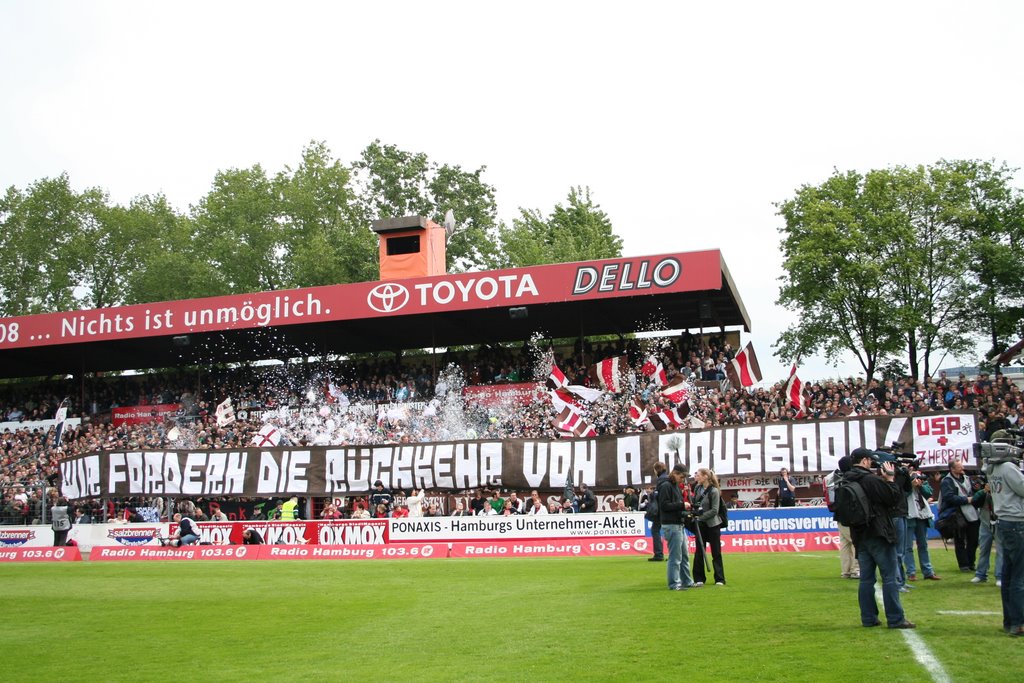
We demand the return of Alassane Mousbaou!


Stop all deportations to the Dictatorship in Togo!

FC St.Pauli/ 7. Herren

Name: Alassane Mousbaou member of St Pauli 7. Herren since 09/03

What could be said: Sometimes even tries to use the goalpost. And is the only one to try a bicycle kick on a hard court.

Even passion for football and enthusiasm for FC St.Pauli is punishable for refugees under German law if they do not live in Hamburg. Asylum seekers in Germany are denied basic human rights. They are often placed in isolated asylum homes and camps and are forbidden to leave their district (“Landkreis”) without special permission. A violation of this German Apartheid Law, the so-called “Residence Obligation” (Residenzpflicht), is punishable with up to 5000 Euro or one year imprisonment. Alassane, whose freedom of movement was limited to the district (Landkreis) Ludwigslust in Mecklenburg-Vorpommern, could have never played with the FC. St.Pauli if he had accepted this racist law. Alassane has another story. He was an active member of the opposition in his home country Togo. This small West African country, has lived under bloody dictatorship for the past 40 years. After the terror of the German and after French colonialism (1918), Togo fought for its independence (1960). With support from Europe, the new democratically elected President Olympio was murdered after only three years and the former foreign legionnaire General Eydema took over power. He made Togo into a puppet regime of Europe. Until today the dictatorship serves Europe as bridgehead for arms traffic, the organization armed conflicts, and coups d'etat in the entire region. After the general´s death in February 2005, his son took over power. His militias killed around 1000 people within a few months and ten of thousands fled to the neighboring countries. Europe continues to support this new old dictatorship.

Alassane came under scrutiny of the regime in 2001. He managed to flee and came to Germany. The banality of evil followed. His asylum petition was denied as unfounded. Alassane continued his political struggle while in exile and got involved with the “The International Campaign Against the Dictatorship in Togo and Other African Countries” (IC). In December 2005, he was detained by the foreign authority (Ausländerbehörde) and placed in deportation detention. When he demanded to call his attorney, one of the authorities grabbed him from behind and choked him. He was brought to the JVA Bützöw Prison. Outside a massive support campaign was underway. Even UNHCR demanded an-examination of Alassane´s asylum proceeding. While the PDS/SPD government of Mecklenburg-Vorpommern came under increasing pressure, a secret operation was planned. On January 31, 2006, a police commando stormed the prison hospital ward. Alassane was torn from bed, brought to the airport, and deported under police supervision. His attorney was denied information for hours the next day. At the airport, in Lomé (Togo), Alassane was held. A technical sergeant of the military presented him with photos and documents of the exile opposition in Germany. He was called a bandit of the IC. Only after the intervention of the Togolese human right league was Alassane released. Already on the next day, the militias came to Alassane´s friend´s house to arrest him again. But he was not there. The militias now threatened his friend. When they came a second time, Alassane and his friend fled to Ghana. Even in the neighboring country, the militias of the Togolese regime can operate unhindered, so that Alassane and his friend have remained in hiding in Ghana since February. Alassane´s attorney is still waiting for a court date in his asylum case, in order to make his right to return valid. „The international campaign“ (IC) continues to mobilize against the collaboration of the German authorities with the dictatorship in Togo. On April 14, 2006, the Minister of the Interior of Schwerin, Gottfried Timm, had to issue a six-month deportation stop to Togo. This stop applies only to the Federal State of Mecklenburg-Vorpommern. The other Federal States continue the criminal practice of deporting the refugees from the dictatorship in Togo. Hamburg has planned a mass deportation to the West African dictatorship via charter flight at the end of April. The overall asylum recognition rate in Germany is about 0,9 %. Increasingly recognized refugees, who have lived in Germany for years or decades, are having their status taken away by means of a revocation procedure (Widerrufsverfahren). The following justification is given: “You are no longer in danger in your country.” The constantly growing institutional racism of the German government drives Nazis on the street to more and more attacks on everyone who does not look “German.” While the media in Germany has launched a campaign “You are Germany “ (just as during the Third Reich; NSDAP facists already used the same wording in the 30's), refugees and migrants experience the other side the coin: “You Are NOT Germany.” Everyone, with any dignity left in them, must be nauseated by the German football World Cup slogan: “The world as guests with friends” together with a policy and official practice, which puts into practice the Nazi slogan “Germany for Germans - Foreigners Out.”

We call on everyone to fight racism everywhere by all means necessary!
We call on everyone to support the fight for Alassane´s rights and the rights of all refugees and migrants!

weitere Infos siehe: http://www.thecaravan.org

Donations for attorney costs, support for Alassane, materials, etc.
Spendenkonto (bitte Stichwort nicht vergessen):
Antirassistische Initiative Berlin; Bank für Sozialwirtschaft;
Kto: 30 39 600; BLZ: 100 205 00 Stichwort "Togo-Kampagne"

Internationale Kampagne gegen die Diktatur in Togo und anderen afrikanischen Ländern
Karawane-Hamburg Tel: 0049-(0)40-43 18 90 37
c/o Brigittenstrasse 5 Fax: 0049-(0)40-43 18 90 38
20359 Hamburg mail: free2move@nadir.org / http://www.thecaravan.org

Tuesday, May 09, 2006

Young refugees demand right to stay


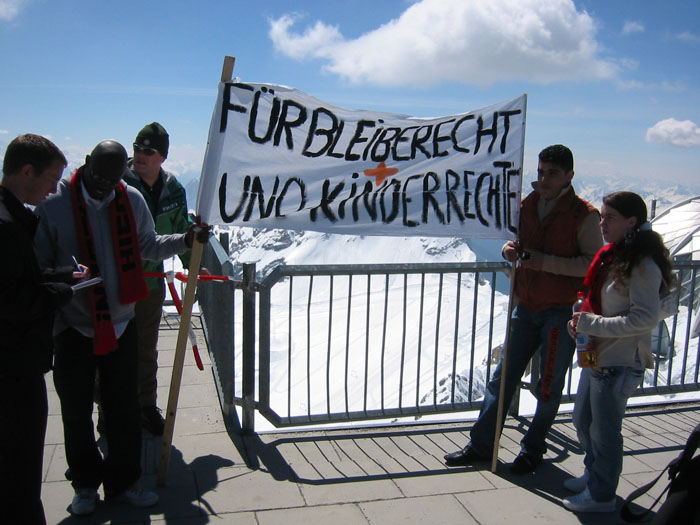
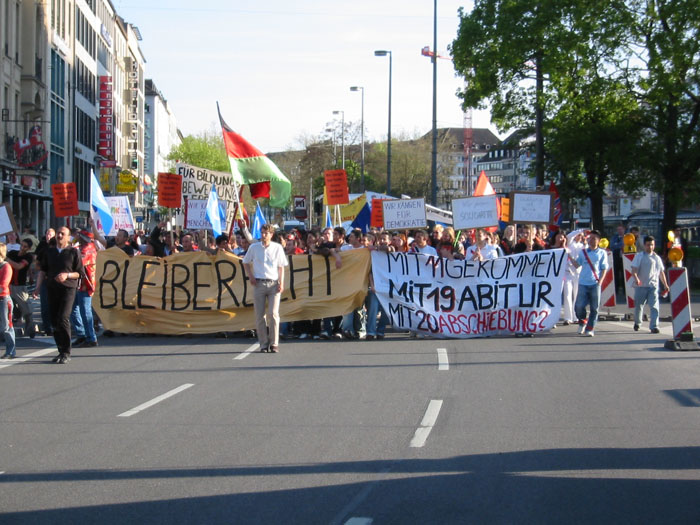
As Germanys ministers of inner affairs were meeting in the pitoresque Bavarian town Garmisch Patenkirchen young refugees from all over the country came to demand a right to stay. Unfortunatedly the ministers didn't agree to that they rather agreed on increasing the number of deportations instead, but the demonstrations in Garmisch Patenkirchen, Munich and even on the top of Germanys highest mountain the Zugspitze were a big success.
More Informations on http://www.hier.geblieben.net

Tuesday, May 02, 2006

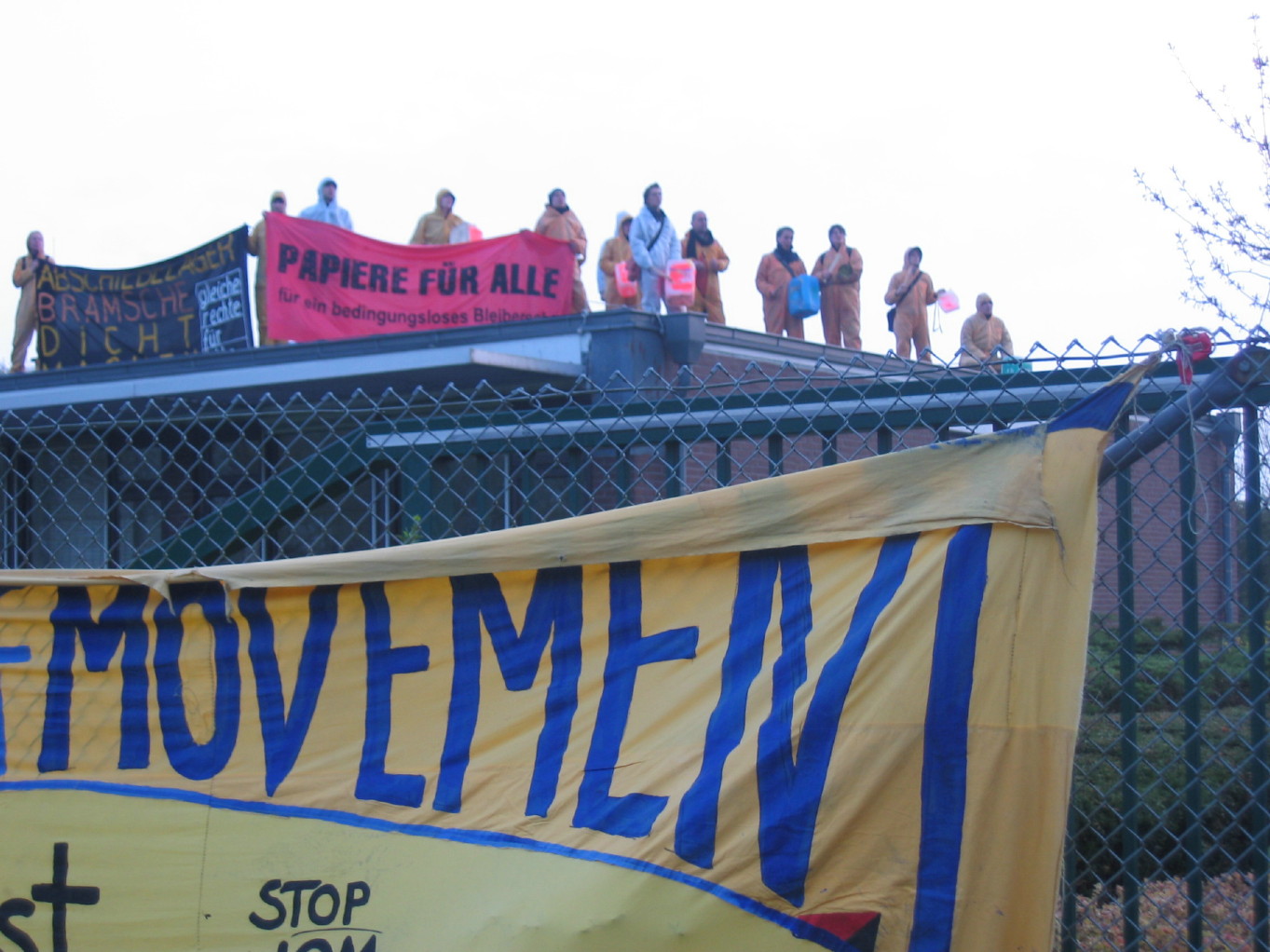
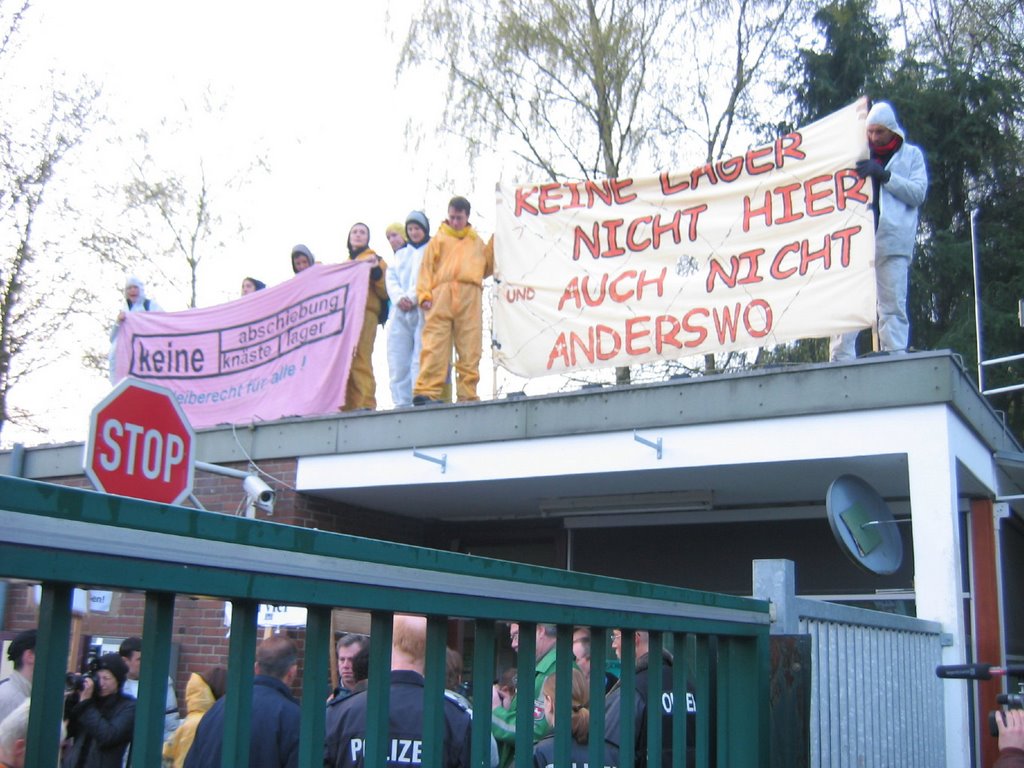
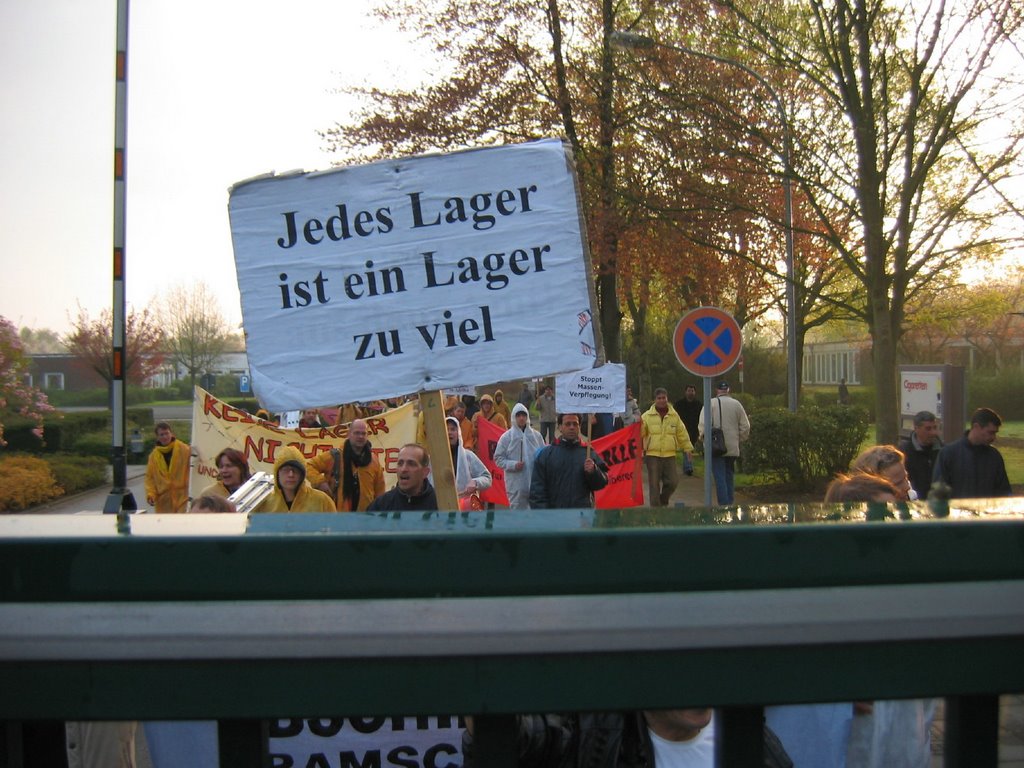
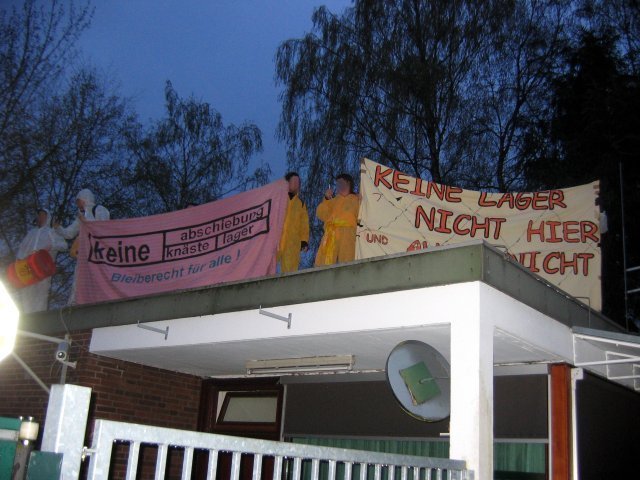
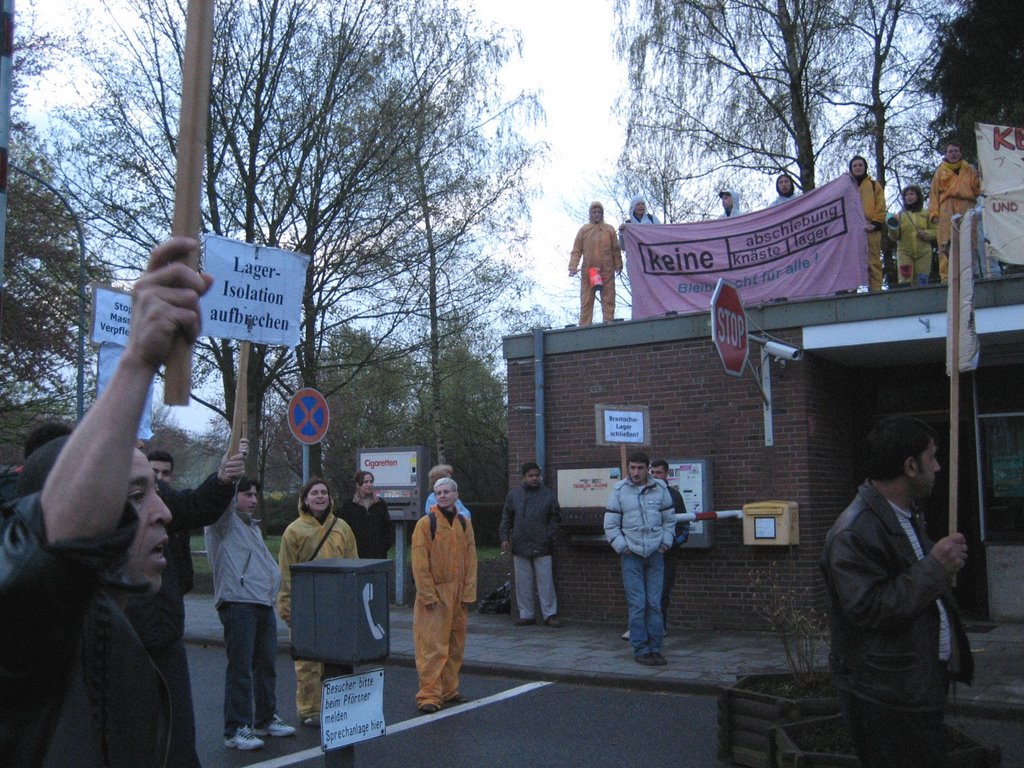
We jump the camp guards on the roof - shut down deportation camp Bramsche-Hesepe


This morning activists occupied the roof of the checkpoint at the entry of Germanys largest deportation camp in Bramsche-Hesepe
After one hour the activists started a demonstration through the lager compound together with the inmates. The state employed racists from the ferderal office on migration (Bundesamt) only dared to enter theii offices protected by police.

But the character of the demonstration was very peacfull and ended without incidents despite the controls of everybodys IDs.

Wir steigen der Lagerleitung auf das Dach – Abschiebelager Bramsche-Hesepe schließen!!


Pressemitteilung aus Bramsche-Hesepe vom 2. Mai 2006

In den frühen Morgenstunden des 2. Mai wurden die Dächer der Behörden des Abschiebelagers in Bramsche-Hesepe von einer Gruppe AktivistInnen besetzt. Mit dieser Aktion sollte die Forderung nach Schließung des Lagers unterstrichen werden, die seit Bestehen des Lagers sowohl von BewohnerInnen als auch von UnterstützerInnen immer wieder erhoben wird. Pressemitteilung zum Download

Update:
Um kurz vor 7 Uhr startete zwischen den besetzten Dächern eine Demo durch das Gelände des Abschiebelagers. Obwohl die Polizei bereits sehr präsent war und die Sicherheitsleute vom Lager die Flüchtlinge mit Drohungen wie "Wenn ihr so was macht, dann gibt es hier heute kein Essen!" einzuschüchtern versuchten, war die Stimmung bestens.

Die Schreibtischtäter vom Bundesamt für Migration wurden von Sprechchören empfangen und trauten sich nur mit Polizeischutz in ihre Amtsstuben.

Um ca. halb acht wurde die Aktion beendet. Bei der Abfahrt, wurden jedoch von allen Teilnehmenden Personalien festgestellt.


Dieses größte Abschiebelager Deutschlands liegt versteckt im Wald, wie die meisten der Sammelunterkünfte für Flüchtlinge in Deutschland. Das entspricht der Abschottungs- und Abschiebemaschinerie, in die Menschen geraten, die nichts anderes suchen, als ein menschenwürdiges Leben, ein Leben ohne Verfolgung, ohne Angst vor Hunger und Tod und ohne Repression.

Mit welchen Schicksalen und Fluchthintergründen auch immer, wenn die Menschen in diesem Lager landen, geraten sie in einen neuen Apparat von Repression, der zum Ziel hat, die Menschen zur sog. „Freiwilligen Ausreise“ zu zwingen oder abzuschieben.

Zu diesem Apparat der Repression gehören die Lebensbedingungen in dem Lager, mit kaum einer Privatsphäre, mit der fast völligen Bestimmung des Alltags von den Strukturen des Lagers und es gehören dazu die Repressionen von Seiten der Behörden, das Verweigern der wenigen Geldmittel, die Flüchtlingen zustehen, das Arbeitsverbot, das Verhängen von Geld- oder Haftstrafen, wenn die Behörden entscheiden, daß ein Flüchtling angeblich seiner Mitwirkungspflicht nicht genüge tut.

Das Abschiebelager in Bramsche-Hesepe ist eingebunden in ein europaweites Lagersystem, das Teil der Politik der „Festung Europa“ ist. Die Fluchtwege nach Europa werden immer schärfer kontrolliert, mit einem unglaublichen technischen und finanziellen Aufwand, der zur Folge hat, daß Flucht immer lebensbedrohlicher wird. Erste Lager für Flüchtlinge, aus denen sie wieder in ihre Herkunftsländer abgeschoben werden sollen, befinden sich an den Außengrenzen Europas. Weitere Lager befinden sich an den Innengrenzen, für die Flüchtlinge, die es trotzdem geschafft haben, die Grenze Europas zu überschreiten. Das Lagersystem wird ergänzt durch die Lager in den einzelnen Ländern Europas, zu denen auch das Abschiebelager in Bramsche-Hesepe zählt.

Weltweit steigt die Zahl der Flüchtlinge – doch immer weniger Menschen schaffen es in die reichen Länder und diejenigen, die es schaffen, sollen so schnell wie möglich wieder ausgewiesen werden.

In diesem unmenschlichen Regime ist das Lager in Bramsche-Hesepe ein Baustein. Zudem ist es ein besonderes Symbol, weil es Modellprojekt dafür ist, wie in Zukunft in Deutschland Lager aussehen sollen, wie also in Zukunft mit Menschen umgegangen werden soll. Verantwortlich für diese Zukunft sind u.a. Deutschlands Innenminister, die am 4. und 5. Mai zur Innenministerkonferenz in Garmisch-Patenkirchen zusammentreffen. Leider ist nicht damit zu rechnen, dass sie die kommende Konferenz nutzen werden, um die Lebensbedingungen von Flüchtlingen zu verbessern, sondern vielmehr um Abschiebungen weiter zu forcieren.

Flüchtlinge aus Bramsche-Hesepe haben schon oft gegen ihre Unterbringung protestiert und gemeinsam mit UnterstützerInnen die Schließung gefordert. Doch die verantwortlichen Behörden und PolitikerInnen schalten auf stur.

Deshalb haben wir heute mit der Aktion das Lager ein weiteres Mal in das Licht der Öffentlichkeit gebracht.

Für die Abschaffung der Lagerunterbringung für alle Flüchtlinge!
Für offene Grenzen und für Bewegungsfreiheit für Alle!
Für freies Fluten!


Friday, April 21, 2006

Support Kazim Popal

Kazim Popals life started in Afghanistan in1978.. Most of his family was killed during the war. The political situation in Afghanistan soon left him no other choice than to leave the country.

This brought him to Denmark.

Since he arrived, he has finished the manditory language school in almost no time, taken many evening classes with a wide range of subjects including psychology, and has an internship.

He even works for the Danish Red Cross.

April 5th he was arrested and sent to a fugitive camp. He was deported April 19th.

Denmark requires integration, but KAZIM has done everything by the book, and that still isn't enough.

We might help him come back!
Please send the link http://www.ampetition.dk/kazim/ to as many people as you can, in order to sign the petition. Everyone counts!

Friday, April 14, 2006

Mecklenburg Vorpommern stoped deportations to Togo until 10th of Oktober

Thanks to all the effords during the struggle of the 'International campaign against dictatorship in Togo and other African countries' after the recent meeting of officials with "experts" who all clearly condemned any deportation to this dictatorship the government of the German state of Mecklenburg Vorpommern was forced to stop deportations to Togo for 6 months!

But this does not mean, there was time to relax. All other sttes continue their deportation practice. We have to continue the struggle for deportation stop in the whole country.

Please sign the petition to the German parliament to stop the deportations.

The petition is at: http://thecaravan.org/files/caravan/Petitionsantrag_kurz.pdf

read the English text of the petition:

From:

To:
Deutscher Bundestag
Petitionsauschuss
Platz der Republik 1
11011 Berlin
Tel: 030-22735257
Fax: 030-22736053
Email: Vorzimmer.Peta@bundestag.de

Petition

Concerning: Protection for Refugees from the Togolese Dictatorship and Nationwide Deportationstop to Togo

Ladies and Gentlemen:

The German Bundestag (German parliament) may decide that--according to the corresponding articles of the General Declaration of Human Rights, the International Convention for the Protection of Refugees, and the German Asylum Law-- refugees from Togo who fled from the dictatorship in their home country are granted protection in Germany and that deportations to Togo will not take place.

It is unacceptable and against human rights that German authorities, especially the BAMF (“Bundesamt für Migration und Flüchtinge” //Federal Office for Migration and Refugees).and the “Auswärtiges Amt” (AA--Foreign Ministry) and the majority of the admiistrative courts that decide mainly on the basis of the report from the AA, refuse to give refugees from the Togolese dictatorship the garuanteed right of protection against persecution.

It is unaceptable that, on one hand, the situation in Togo is described correctly (though not clearly enough), to the effect that it is an autocratic regime with a very efficent and repressive security machinery that, brutally and by all means, oppresses every questioning of its total supremacy. On the other hand, the authorities in Germany see no reason for a dangerous situation for asylum seekers from Togo.

Human rights organisations and the UNHCR have made it unmistakably clear --and the the AA is informed about this position -- that the official and unofficial Security Forces of the RPT-Regime act unpredictably and arbitrarily against oppositionists or those suspected of belonging to them. Spies of the regime are everywhere. It is wrong to say that only highly committed and leading members of the opposition are persecuted. The counter-evidence is shown by several tens of housands of refugees in the neighboring countries. Especially, the not well known opponents of the dictatorship face the threats and the attacks of the militia and the RTP-members without protection
.
It is wrong and only serves the aim of deportation and refusing asylum, when the AA and the Bundesamt claim that refugees who are being deported from Germany do not face any danger when they arrive in Togo. Firstly, there are some concrete examples where it is the other way round; the recent ones are the case of Alassane Mousbaou and of the Togolese-refugee from Bavaria who was deported on the 10th of January and arrested and beaten right after he arrived. And secondly, the regime knows pretty well that attacks against the deported persons at the airport itself could cause trouble with the German authorities. But since it is necessary that family or friends always have to vouch for the deported one and have to give a concrete adress, the regime has time and patience to organise their repression without the knowledge of the public. That is why a lot of deported opponents of the regime flee again right after their arrival.

These facts have been confirmed indirectly by the AA in the “kleine Anfrage”(short inquiry) (BT-DRS. Nr: 16/571)which says::” According to our knowledge the Togolese authorities generally try to treat the returning people in a correct manner, so that neither the German authorities nor the Togolese exile organisations have a reason to criticize them”

So it is confirmed, as one knows anyhow, it is all just tactics.

It is wrong and only serves the aim of deportation and asylum refusal when the AA and the Bundesamt claim that exile political activities cause no persecution. The exile political activities are a thorn on the side of the regime, because the character of the Eyadema.RPT-powers will be exposed to the public and will damage the relations and negotiations with the European countries. Protests like the ones at the EXPO in Hannover, the rally at the Togo embassy in Paris during the Africa-France Summit 2003, the hunge rstrike of the “International Campaign Against the Dictatorship in Togo” in Berlin 2004 caused reactions from the side of the regime in Lomé. Repeatedly the refugees from the dictatorship were discribed as bandits. During the stay of the spokesperson of the “International Campaign” in West Africa in spring 2004, there was a search for him in Togo and Ghana. Alassane Mousbaou was confronted with the acivities and pictures of the “International Campaign”. His deportation, against all warnings, has lead to the fact that he is now living under precarious conditions, hidden in Ghana. His friend, who picked him up at the airport and vouched for him, is also being searched for by the regime and had to flee.

The Niedersachsen Refugee Council, referring to the recent report of the AA, said:” The report corresponds to the usual pattern that the AA usually uses: First, the general political conditions in the country are described (violations against human rights, no independent legal system, torture, police attacks etc.) in a quite realistic way. But then, as a second step, it is declared, that Togolese refugees in Germay are not affected by all this when they go home.”

This continuing policy of human rights violations against refugees from theTogolese dictatoraship has to come to an end and their rights have to be restored.

In this sense, the Petition Committee is asked to guarantee the protection of the affected ones and to help realize the long-demanded deportation stop to Togo.

Signture:

Date:

Sunday, April 09, 2006

International Refugee Human Rights Tour - 29th of July till 5th of August 2006

Munich – Neuburg – Landshut - Nuremberg

Refugee camps are a means of oppression, economic exploitation and isolation. The AntiLagerTour calls to end this inhuman internment and to end a policy which discriminates, isolates and criminalizes refugees.

Further information: www.deutschland-lagerland.de, carava.net

Abolish refugee camps!
Give up exclusion!
Stop isolation!

Refugees living in refugee camps are denied fundamental human rights. They have no privacy, they are excluded from the society they are living in, they are threatened by infectious diseases, psychologically worn down and subjected to repression, they are excluded from education, they are economically exploited and can’t even decide for themselves what they want to eat. So Elvisa B. asks angrily: “"What can I give my children to eat?" On Thursday, Elvisa arrived late to the food parcel distribution because she had been at the doctor with her youngest child. The next food parcels are due the next Thursday only, and only if she is lucky, they haven't been cancelled at all. When she was thirteen years old, she fled the war in Bosnia together with her parents. Today, the 26-year-old woman lives as a single mother in the largest refugee camp in Southern Bavaria, at Neuburg an der Donau. Since she is not allowed to work, she and her three little children have to live on the contents of the food parcels.

Why refugees are here

Elvisa B. and her children share the fate of thousands of refugees in Bavaria, who have left their countries because of war, political or religious persecution, poverty, hunger, racist or sexual discrimination, among them refugees that fled war in former Yugoslavia, men and women from Iran and Afghanistan, from Iraq or Congo, oppositional people who have fled from the European-Union-supported dictatorships in Ethiopia and Togo. Like the Afghani family A., who live in the refugee camp in Landshut. For their three daughters, who have grown up in Germany, it is unimaginable to return to Afghanistan, where they would have to comply with the harsh rules of feudal leaders. Or Ahmed D. (27), a stateless Kurd who fled oppression in Syria. He inhabits half a room in the Munich refugee camp of Emma-Ihrer-Strasse. It is not
suitable for handicapped people, but who cares for the needs of a person in a wheelchair but without passport?

Refugee camps shall enforce “the readiness to return”

These are three stories, but there are thousand more to be told. All these people are forced by law to live in refugee camps. Usually, these camps are barracks or containers, separated from the rest of the population by fence or isolated location outside residential areas. There, privacy doesn't exist, people have to share little space. Up to four people have to share a room of 15
sqm, showers and toilets are communal, as well as the kitchen if existent. The bosses of the camps and the police arbitrarily control people, times for visits are limited and people live in fear of being taken at 5 o’clock in the morning for deportation- all this is part of daily life in the lager. This permanent state of exception makes many inhabitants physically and psychologically ill. It is forbidden to rent an own flat, even if one could afford it. The forced stay in camps, is supposed to "encourage the willingness to return to the country of origin", as the Bavarian ministry of the interior puts it.


Systematic exclusion and isolation

Refugees are barred from work and therefore condemned to be idle. Only after one year, they have the theoretical chance to obtain a work permit, but with "subordinate access" to the labour market only. So, refugees have to find and employer who gives them a written confirmation that he/she wants to employ them. With this confirmation, they have to apply for a working permission. But usually, these jobs, which had been confirmed for refugees, are given to other people looking for work by the work agency. The gratitude for this creative way of announcing free jobs is frustrating- the refugees get nothing. In this way, refugees and other jobless people are played against each other. Those who manage, in spite of all difficulties, to get a working permission, cannot feel safe. At the moment, many people who had got a working permission in the past are withdrawn again this working permission. Anyhow, they have no claim to get unemployment benefit, although they have paid unemployment insurance for years. Thus banned from securing their own subsistence, refugees are treated as second class citizens: Twice a week, the company "Drei Koenig" from Schwaebisch Gmuend (Baden-Wuertemberg) delivers food parcels which at times contain foul food, or food past their best-before date. This inadequate supply of non-cash benefits, accomplished by second-hand clothes and toilet paper, deprives human beings from any form of self-determination. In cash, refugees in Bavaria have 40 Euros a month (20 for children), which are spent for additional foodstuff, bus fare, medication of toys for children. In many cases, even theses benefits are reduced or even cancelled as a means of sanctioning. Because of "Residenzpflicht", refugees are not allowed to leave the constituency they live in. An infraction against this law is often avenged with fines or imprisonment. In this way, refugees are criminalized for visiting their relatives and friends and for engaging themselves politically and socially. Furthermore, due to this criminalisation, refugees are later refused the right to stay with reference to their previous convictions.

The inability to integrate into the world society

This exclusion, isolation and criminalisation is characteristic for refugee policies not only in Bavaria, but also in Germany, Europe and all over the world. The European-Union-states try to make Europe an asylum-free zone- with deadly consequences: People drown in the Mediterranean, are shot at the fences of Ceuta and Mellilla, or they are set out in the desert of Libya and Morocco. With foreigners' laws, borders, camps, prisons and deportations, European Union states try to control who stays and is allowed to stay in their sovereign territory. But this means more than only sticking to the antiquated nationalist ideas of the 19th and 20th century. In that way, they insure their dominance in a worldwide capitalist system – a system which denies the access to vital economic, natural and social resources for the majority of all human beings and which simply devastates large parts of the world for economic profit. While they concede more and more freedom of movement to capital and goods in the globalised
economy of today, they restrict the freedom of movement of six billion "members of the human family" (general declaration of the human rights) by more and more rigid means. This refugee policy ignores a reality in which there have always been and will always be human beings who will try to escape a situation threatening their very existence and to find a better living perspective for themselves and their families, despite all legal attempts to thwart this.
States that chose to ignore this reality prove their very incapability to integrate into a global society. By clinging to their nation state ideology, they accept to agonise people, to deprive them of their rights and to violate their human dignity.

Human Rights can’t be achieved by begging for them- they are claimed by fighting for them!

Worldwide, refugees protest against being excluded, isolated and criminalised by law. This discrimination because of their country of origin is a violation of the human rights. During the last few years, the struggle against such policy has also taken place in Bayern in the form of public protest, boycott of food packages or many, often publicly invisible, acts of daily resistance against bosses of camps, authorities and police harassments. We feel linked to this struggle. We, refugees and supporters, jointly demand to respect the human dignity of refugees and to guarantee their rights and needs. We ask you to demand, together with us, the abolition of all refugee camps and an immediate end to the practices of “legalised” exclusion, isolation and
criminalisation of refugees.

We demand:
- Abolish refugee camps – free choice of residence!
- An end to exclusion and isolation!
-The right to stay for everyone!
- No food packages, but money, so that everyone can buy the food that she/he desires!
- Abolish Residential Restriction Law (“Landkreis-Residenzpflichtgesetz”)!
- Stop criminalisation of refugees and racist controls!
- Equal right to work!
- Fight racism- equal rights for everybody!