Saturday, August 11, 2007

Art in occupation

MARK VALLEN'S "ART FOR A CHANGE": On Decorating The Blast Walls

On Decorating The Blast Walls

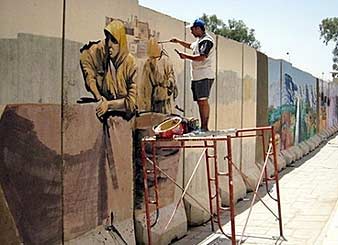
Associated Press photograph by Khalid Mohammed, July 20, 2007

When pondering the above photograph of an artist painting a mural, what comes to mind? That the artist is playing a constructive role in society by creating a public work meant to beautify his community? Of course there are many possible reactions to the photo, but in describing the actual circumstances in which it was made, suddenly a different set of responses come into play - as well as questions regarding the social purposes of art. A closer examination of this photo can tell us something about the art and artists in our own respective communities.

The photo was taken on July 20, 2007 by Associated Press photographer, Khalid Mohammed, and it shows an Iraqi artist painting a mural on the steel and cement blast walls erected by U.S. occupation troops in downtown Baghdad, fortifications meant to protect government buildings from car bombs. Commissioned by the U.S. backed, Shiite dominated central government, the artist’s mural is part of a government funded "beautification project", where non-controversial and colorful murals are being created and installed on bomb blast walls all across Baghdad. In painting the ramparts of a military occupation, does the Iraqi artist somehow make life better for his people? I don’t mean to say that art should not serve to ameliorate suffering and bring joy to the soul - those are, I believe, some of the main reasons why we create works of art. As Albert Camus once observed, "We have art in order not to die of life." But when we create art, who is it for, what is its purpose, and what are its ramifications?
...
On the other hand, those artists who want their works to have a noble purpose, can fall into a trap of a different sort. In the Summer of 2005, British graffiti artist, Banksy, traveled to the West Bank to leave a series of stencil murals on Israel’s so-called "security fence" surrounding the Palestinian territories. On his website the artist wrote: "How illegal is it to vandalize a wall, if the wall itself has been deemed unlawful by the International Court of Justice? The Israeli government is building a wall which stands three times the height of the Berlin wall and will eventually run for over 700km - the distance from London to Zurich." Once Banksy began his murals, he was confronted by an old Palestinian man who said, "You’ve painted the wall and made it look beautiful." The artist replied with a "Thank you", only to be admonished by the elder, "We don't want it to be beautiful, we hate this wall. Go home!"

Too many walls
[ British graffiti artist Banksy, painted this image on Israel’s so-called "security fence," at the West Bank crossing point from Ramallah to Jerusalem. ]

Read the full article on
MARK VALLEN'S "ART FOR A CHANGE" blog:
On Decorating The Blast Walls


Labels:

Now is the time to parole the MOVE 9

NO EXCUSES! NOW IS THE TIME TO PAROLE THE MOVE 9! NO EXCUSES!

DOWNLOAD PDF FLYER HERE

We will assemble at 45th & Kingsessing Ave. at 12:00pm, August 11 in Philly

For transportation from NYC, call (212)330-8029


HISTORY OF THE MOVE 9

This August 8th will mark the 29th anniversary of the 1978 confrontation in Philadelphia that was completely provoked and carried out by the Philadelphia police. Over 600 heavily armed police officers came out to MOVE headquarters to serve an eviction order to MOVE members, charging them with failure to leave their Powelton Village headquarters in supposed violation of an earlier agreement. With their concocted story to justify a military invasion, public officials and the media blamed MOVE for the deadly assault that followed.

On the morning of August 8, 1978. police fired over 1,000 rounds of ammunition into a basement that was filled with MOVE men, women, children, and animals. The police flooded the basement in an attempt to drown MOVE members. They fired tear gas knowing full well that MOVE babies would be gassed. In their bloodthirsty frenzy to kill MOVE members, the police killed one of their own fellow officers. As MOVE members came out of their house, mothers had their babies snatched out of their arms and were shackled. MOVE men were savagely beaten and shackled.

The police, rather than admitting that they had killed one of their own, charged nine MOVE members with the murder of the one police officer, James Ramp. The nine were, as in the case of Mumia, tried and convicted for the murder of the police officer. Each member was sentenced to 30-100 years in prison. The trial judge admitted, when questioned by then still unimprisoned journalist Mumia Abu-Jamal, that he did not have the faintest idea as to who shot the cop. He said he had sentenced the MOVE members as a family because they insisted that they were a family!

It was partly because of Mumia’s extensive and fair reporting on MOVE, rare among Philadelphia journalists, covering all the events that led to August 8th as well as the trial and conditions of imprisonment for the MOVE 9, that he was later framed. Mayor Rizzo specifically threatened Mumia for what he defined as biased reporting.

That was 29 years ago. MOVE members are still in prison today. Merle Africa died in prison under mysterious circumstances after doing 20 years. August 1978 led directly to the infamous bombing of MOVE on May 13, 1985, as MOVE would not stop protesting the incarceration of their nine sisters and brothers.

We cannot allow one more freedom fighter to die in Amerika’s dungeons! A year from now the MOVE 9 will go before the parole board for the very first time. Interviews will begin in the next few months. Join us in a campaign of massive steady public pressure to bring our freedom fighters home. The struggle to parole the MOVE 9 is key to reinstating the right to parole for all prisoners.

NO EXCUSES! NOW IS THE TIME TO PAROLE THE MOVE 9!

Free Mumia Abu-Jamal Coalition (NYC) • info@freemumia.com • (212) 330-8029


'Free the MOVE 9' von azadi

Free Mumia Abu-Jamal Coalition, NYC

Friday, August 10, 2007

Collaboration of the Nigerian Embassy in the deportation of Nigerians from Germany

Call to Action! Against the Collaboration of the Nigerian Embassy with the German Authorities

Collaboration of the Nigerian Embassy in the deportation of Nigerians from Germany

As we, the Caravan for the Rights of Refugees and Migrants, Munich, have recently learned, the Nigerian Embassy is coming to Munich, Germany, in order to issue ‘travel certificates’ (TC) for Nigerians living in Munich to the end of their deportation from Germany. The Bavarian Foreigners’ Authorities have sent letters summoning Nigerians to attend this hearing with the Nigerian Embassy taking place on Wednesday, the 8th of August in the Munich refugee camp in Tischlerstrasse, and the hearings may well span over several days. The Nigerians summoned are being told that they have to attend in order to have their identity clarified, which means that if they are identified as being a Nigerian citizen, they will be issued a TC which in turn will allow the German authorities to deport them to Nigeria.

We strongly protest this decision of the Nigerian Embassy to neglect their duty to look after the welfare of their citizens abroad and rather collaborate with the German Authorities in order to tear Nigerians living in Bavaria out of their lives here and help to put them, forcefully, on a plane bound to Nigeria. This is not the first time that the Nigerian Embassy has come to Munich Tischlerstrasse. When they held these hearings in 2004, we observed a large number of deportations of Nigerians afterwards. We also want to state plainly that with this decision, the Embassy is assuming responsibility for the inhuman and degrading practice of deportation, a practice that already has lead to numerous deaths. It is not long ago that the Nigerian citizen Osamuyia Aikpitanhi was killed by Spanish officers while being deported from Spain in June 2007. The list of persons killed during a deportation is however much longer.

Since we were informed of the Embassy coming down to Munich, we have addressed them in a letter urging them not to come. We have not received a reply, but through an official, we heard that the Embassy went to consult the ‘Bundesamt für Migration und Flüchtlinge’ (the German authority concerned with the issues of flight and migration, BAMF) to ask them what to do. In our opinion, this shows who is giving the orders. Instead of consulting with the relevant authorities in Nigeria how to tackle the issue of providing welfare to all Nigerians abroad (as it is expected of an Embassy), they rather went to consult a German authority infamous for denying the right to stay to many Nigerians, Africans and migrants in general. The Nigerian Embassy claims that there is a German law forcing them to hold this hearings, however it is known to us that various embassies of other countries have stated very clearly that they are not willing to provide such services to the German authorities. We therefore would like to ask about the real motives behind this collaboration. If they were of a personal and economic nature, or of a similar immoral category, the Nigerian Embassy staff would surely have forefeited their right to represent Nigerians abroad.

Given the Embassy’s intransigence, all that remains is public action. We will state our protest in Munich, but we also urge you to send a protest letter, fax or email to the Nigerian Embassy demanding from them to reverse their sinister decision and not to comply with the wishes of the German authorities, wished that only mean the deportation of Nigerians from Germany. Remind the Embassy of their obligations to Nigerian citizens living abroad and let them know that they are acting in a manner that lacks any respect for the Human Rights globally agreed upon.

What you can do

We have prepared a short text that you can use for your protest letter to the Nigerian embassy. Since we need some kind of feedback, we ask you to send us a carbon-copy of your letter.

Via email: info@nigeriaembassygermany.org and carbon-copy to: caravane-munich@zeromail.org

Via fax: ++49 (0)30 21230-212 and carbon-copy to: ++49 (0)89 762236

Via mail: Nigerian Embassy, Neue Jacobstraße 4, 10179 Berlin, Germany and carbon-copy to: Caravane Munich, c/o EineWeltHaus, Schwanthaler Str. 80, 80336 München, Germany

Sample text protest letter

Your Excellency Ambassador Abdul-Kadir Bin Rimdap,

with great distress I have learned of the decision of the Nigerian Embassy to travel to Munich, Bavaria around the 8th of August 2007 in order to issue travel certificates to Nigerians living in Bavaria whose sole purpose is to facilitate the deportation of these people. This is a cruel fate for the victims of such practices, and it in stark contrast with my view that the Nigerian Mission should have an interest in the welfare of all Nigerian citizens living abroad. The dishonourable circumstances under which such a hearing takes place clearly constitute a humiliation of those whose welfare you should have a personal interest in and thus, any kind of such cooperation is prohibitive.

I believe that such an action would have severe consequences which are incompatible even with your interests.
As experience has showed, a large number of Nigerians will be deported from Germany, Nigerians that have established a living here and are often providing vital support to their families at home and their country in general. During this deportation, the people concerned are exposed to the risk of stress, harrassment, maltreatment and even death, as it has recently occured during the deportation of Osamuyia Aikpitanhi, who was gagged and choked to death by Spanish officers, an event that sparked outrage of Nigerians all over the world. If the Embassy were to engage in this activity, you become an accomplice in the inhuman practice of deportation and assume co-responsibility for the death and sufferings of those being deported.

Please do also consider that the relations between Nigerians living in Germany and the Embassy will suffer. Already in the years prior to 2007, Nigerians have experienced the Embassy as a mere extension of the German government because of such activities. As a result, the reoccurence of distrust and fear can be anticipated if such a delegation were to come to Bavaria for said purpose. This consequence can clearly not be in your interest.

I therefore ask you to reconsider your decision and to rather care for the welfare of all Nigerians living in Germany. Don’t send the Embassy delegation to Munich. Refuse to collaborate with the German authorities whose sole aim is the forceful deportation of so many Nigerians living in Germany, a decision taken by many embassies in Germany.

Yours truly,


carava.net » Blog Archiv » Call to Action! Against the Collaboration of the Nigerian Embassy with the German Authorities

26 migrants escape immigration prison in Oxford

Around 10:30pm on Saturday, July 4th, a riot broke out in Campsfield House, Oxfordshire, leading to 26 migrants escaping the immigration prison. 15 have since been recaptured, while the rest are still on the run. It followed a yard protest on Tuesday night against the appalling conditions inside the detention centre, which is run by American company GEO, and the discriminatory decisions of Newport immigration court, which is used for bail hearings and appeals involving Campsfield detainees. A hunger strike was started on Wednesday but was put on hold pending a meeting with Home Office representatives on Friday. A further yard protest on Friday night was held as the meeting failed to meet the prisoners' demands. Three solidarity demos were held on Tuesday midday at Campsfield House, Lindholme (Doncaster) and the Communication House (London) [reports: 1 | 2 | 3 ].

Last week, a revolt in a detention centre in Bari, Italy, led to at least 35 migrants escaping. Three weeks ago, 69 Tamil detainees in 5 detention centres, including Campsfield, went on hunger strike against a Home Office decision to deport them back to Sri Lanka [appeal]. Many are still on hunger strike while two Sri Lankan detainees in Harmondswoth, near Heathrow, have been on hunger strike for almost a month (see also Immigration detention: Unworkable).

Links: Campaign to Close Campsfield | No Borders UK

According to the Campaign to Close Campsfield, detainees were evacuated into the yard at around 10:30pm on Saturday after a fire in the centre's makeshift kitchen (a Portakabin where the centre's detested diet of chips is prepared). There was allegedly a risk that the large gas bottles stacked outside would explode. Then, at about 10:45, reports came in that a group of detainees were smashing through the back gate. At about 11:30, detainees were being marshalled back into their cells and locked in, while a police helicopter was circling around. No fewer than eight fire appliances were seen. Hoses were being paid out although the kitchen fire had reportedly been extinguished.

A while later a new fire broke out in one of the accommodation blocks and detainees were evacuated into the yard again. Meanwhile, another group were trying to break out but these did not succeed. About 6 police vehicles were already at the side gate, with dogs and some officers donning riot gear. There was a moment of drama when the "spacemen" approached the penned-in detainees and were pelted with mud, small stones and insults.

Around 6:30 on Sunday morning, detainees were taken back inside and were "locked down" with police lining the corridors of the centre.

A statement by detainees at Campsfield House on Tuesday read:

“Newport immigration court, which is used for bail hearings and appeals involving Campsfield detainees, is very discriminatory compared to other courts in the UK: the bail application and appeal success rate there is less than 5%. Living conditions for detainees are appalling. Campsfield is a health hazard with 70% infection with flu. Paracetomol is the only medicine made available; two weeks ago even this ran out. Campsfield was rife with scabies, but only staff were issued with gloves. Although detainees are held civil detainees, not convicted prisoners or prisoners on remand, food, toilets and showers are a lot worse than in prisons. Some detainees are being held even though they have won an appeal against deportation. Others have clearly stated that they want to go back to their country of origin but have still been waiting in Campsfield for months.”

A statement by No Borders UK noted that police have portrayed the escapees as criminals, urging members of the public to "contact us immediately should they see anyone they believe could be one of those involved." Seeking asylum, the statement added, "is not a crime and these people should not have been imprisoned. We call upon members of the public to assist these vulnerable people." The BBC had proudly reported that a local resident in Kiddlington tackled and detained one of the escapee asylum seekers who had asked him for help, while some so-called refugee support organisations urged the escapees to turn themselves over to the police. The former chairman of the Joint Council for the Welfare of Immigrants Imam Sajid, for example, was quoted saying "It is hard to be sympathetic towards anyone who breaks the law, but these men must be desperate."

Campsfield immigration prison

Campsfield House was converted into an immigration detention centre in 1993, amid a storm of protest from local residents [history]. The so-called Immigration Removal Centre (IRC) is run by GEO, the private US prison company previously known as Wackenhut, which took over from Group 4 in May 2006. The centre, surrounded by 20ft fences with razor wire on top, holds up to 200 male asylum seekers at any time. Within 6 months of its opening, six asylum seekers escaped following a rooftop protest. Regular demonstrations and pickets outside Campsfield, mainly organised by the Campaign to Close Campsfield, have since become a common occurrence.

In March this year, Campsfield witnessed another riot when detainees tried to intervene and stop a forceful 'removal' of a fellow Algerian detainee. Following the 'disturbance', Robert Whalley CB was asked by the Home Office to extend his investigation into the Harmondsworth 'disturbance' on 28-29 November, 2006, to that establishment as well. Among other things, Mr Whalley said:

“The Harmondsworth and Campsfield House disturbances were very different, both in causation and in how they unfolded. Both occurred at a time when recent population pressures, falling heavily on vulnerable fabric in a hard-pressed detention estate, were accompanied by dislocation in casework handling, especially in the case of Foreign National Prisoners, which caused a build up of latent tensions.”

“It did not take much to trigger these events. When they started, they soon escalated, despite best efforts to prevent this happening. The underlying causes are still there and, without any changes, the same thing could happen again at either establishment.”

NoBorders

Three more escapees recaptured

07.08.2007 19:05

Police have recaptured three more of the 14 migrants who had been on the run since the Campsfield break-out on Saturday. The search for the remaining 11 still at large continues. Police have been raiding addresses across the UK. On Tuesday, more than 50 officers scoured more than 20 addresses. One man recaptured on Sunday has already been deported back to his country of origin.

UK Indymedia - 26 migrants escape immigration prison in Oxford

Report of antiracist support:

Liam Byrne captured at Campsfield

MINISTER FOR LOCKING UP FOREIGNERS ARRESTED AT CAMPSFIELD

Liam Byrne cut out captured at Campsfield

Yesterday (7/8/2007) members of the Campaign to Close Campsfield held a very successful demonstration outside the immigrant prison, in an effort to redress the balance of reportage on the escapes that took place on Saturday night, and to show the detainees inside that not everyone goes along with the mood of hysteria. There were loud shouts of "freedom" and "thank you very much!" from the main accommodation block, which we addressed by megaphone across the prison's unused, weed-grown football pitch.

Quite a few members of the local media turned up. The event was featured on regional BBC and ITV, and on local radio stations.

One journalist told us that she had done extensive interviews in the immediate locality and "a good half" of the people she'd spoken to were sympathetic towards the escapees, and even wished them luck. This included people living in the houses adjoining the prison, where the media have generally focused on residents who play along with the "escaped criminals" story (extra locks etc).

Less attention is paid to the nature of the crimes the escapees are said to have committed. All that the police will say (and perhaps are able to say because of poor communication with the Borders and Immigration Agency) is that none of them had done anything very bad.

Were it to be revealed that most of the escapees had done little more than failing to return their library books, the official reaction might be seen as a very expensive pantomime, played out for no honorable purpose, at public expense.

THE REAL STORY IS CRIMINALISATION

Since New Labour came to power it has created over 1,000 new crimes. These in particular criminalise the weakest members of society, especially migrants.

"A very high proportion" (say Asylum Welcome and Bail for Immigration Detainees) of the so-called criminals held in Campsfield have been jailed for the new "crime" of using false documents to enter the country. Making this a crime has brought fear back into the lives of thousands of legitimate, established Oxfordshire residents who are now terrified of falling the wrong side of the law in some way. And it blatantly violates Article 31 of the 1951 United Nations Convention on Refugees, which says governments must not penalise refugees who arrive on false papers.

It was for this infringement of international law that we arrested Liam Byrne during the demonstration. It turned out that we had, in fact, only arrested a cardboard cutout, but those who know the Minister say it is an easy mistake to make and, at a mere 2 mm thick, our cutout is certainly not as thick as the original. And a few more people now know what the ex-Anderson consultant, Reid protegée and parliamentary neophyte looks like.

Bob Hughes (Campaign to Close Campsfield)

For more information, contact 01865 726804, 01865 558145 or 07965 292499

Wednesday, August 01, 2007

Swedish government is responsible for the death of Mewan Omer

Swedish government is responsible for the death of Mewan Omer A crime
against refugee rights


International Federation of Iraqi Refugees (IFIR) have been informed that
the body of Mewan Omer an Iraqi Kurdish refugee has been found. Mewan Omer
has been missing for four days. Mewan Omar hanged himself in Olivia,
Valhalbat, Sweden.


Mewan claimed asylum in Netherlands and Sweden but, his claim of asylum was
rejected in both countries. IFIR blames the Swedish Government for Mewvan’s
death. Mewan became depressed after receiving a letter from the Swedish
Government threatening him with deportation. Mewan’s death is a human
tragedy and an outcome of the policy of the Swedish Government to forcibly
deport Iraqi Kurdish refugees


The Death of Mewan should not be forgotten. Human rights campaigners should
continue to put pressure on the Swedish government and press them to prevent
future tragedies such as Mewan’s suicide. Following Mewan’s suicide IFIR
calls on all human rights campaigners, trade unions and civil rights
organizations to join IFIR’s campaign against forcibly deporting Iraqi Kurds
back to Iraq. This is the time to challenge European governments
threatening to deport Iraqi Kurds. IFIR calls on all European countries to
grant refugee status to Iraqi Kurdish refugees.


IFIR expresses its sorrow at Mewan’s death but will continue to campaign
against and challenge the inhumane policies of forcible deportation to Iraq
which led to Mewan’s death.


IFIR held a demonstration on Monday 2nd July 2007, which started at
the front of Gothenburg newspaper marching to where Mewan’s body was found.

COALITION TO STOP DEPORTATIONS TO IRAQ
http://www.csdiraq.com/

German site
Keine Abschiebungen in den Irak
http://irak.antira.info/

Thursday, July 19, 2007

Howard's assault into indigenous communities is Land Grab

2007-07-18 1:01 PM +0800
July 16, 2007: The Howard Government's assault into indigenous communities in the Northern Territory is to access valuable uranium deposits, and not to protect children from abuse, a rally was told in Melbourne last week. More than a hundred community organisations have since criticised the government's plan.

They have described it as a land grab...
Robbie Thorpe, who was also part of the Black GST and Camp Sovereignty protests during the Stolenwealth Games in Melbourne last year, says the Howard is not interested in the welfare of indigenous children.

"It's the only bit of land the commonwealth government hasn't got access to and there are minerals like uranium there," Mr Thorpe told the rally. "That's what it's about. How can you believe Howard? He don't give a f**k about our kids."

He said Indigenous Australians had suffered from 100 years of abuse. "You have taken our people to the brink. "There has been 100 years of human rights' crimes against our people," he said. "Things are not going to change until there is a treaty in this country."

500 people joined the rally. The protest was part of a national day of action being held in capital cities and Alice Springs. In Perth, 120 people rallied. The crowd heard from Ray Jackson from the Indigenous Social Justice Association, Mark Newhouse from the Deaths in Custody Watch Committee and Mark Lawrence from Friends of Australian Rock Art.

About 200 people of all ages and races took part in a demonstration through Canberra to protest against the intervention in Northern Territory communities, likening it to the "Children Overboard" scandal of 2001, or as a land grab or election stunt.

One of the founding members of the Aboriginal tent embassy, Isabell Coe, said the days of Aboriginal people being used as a "political football" had to come to an end. "...what he is doing is disgusting, it is one of the most disgusting things I have ever seen," she said about John Howard's invasion of Aboriginal Lands.

In Sydney, protesters were angry about the compulsory acquisition of remote indigenous communities and the abolition of the permit system, which they consider a land grab. Aboriginal leader Pat Turner said a six-month intervention would be acceptable but had to be done in partnership with local Aborigines.

Mick Dobson says the federal government does not need to seize land from indigenous communities to combat child abuse in the Northern Territory. He said today he feared the government's seizure of 73 communities in the NT was a land grab. "That's what I'm worried about," Prof Dodson said.

"I don't for the life of me understand what the connection between child abuse and land tenure is, why the land tenure has to be given up, albeit for a short period of time according to the prime minister. The two things are not connected," he said to corporate media. "Why steal the land to deal with child sexual abuse?"

Prof Dodson said he, like his brother Pat Dodson, was finding it hard to trust the government on indigenous issues.

SOURCE:

News Ltd
GLW
Canberra Times
Sydney Morning Herald


Perth Independent Media Centre

Oaxaca Government Armed Forces Use Violence to Prevent the People's Use of the Guelaguetza Auditorium

Fighting Erupts on Major Streets and on Fortin Hill


By Nancy Davies
Commentary from Oaxaca

July 17, 2007

“Monday on the Hill,” as it is known in Oaxaca, was banned. One could look up the stairs at nine AM and see the rows of riot police armed and waiting. The stairs to the upper plaza were blocked. The Popular Guelaguetza, sponsored by the movement of Teachers and the Popular Assembly of the Peoples of Oaxaca (APPO, in its Spanish initials) were refused use of the public space.


Photos: D.R. 2006 Nancy Davies
Hundreds of people climbed as far as the military blockade, and then headed off, either south to the Plaza de la Danza where performances were scheduled, or north to where, I was told, the official delegations for the Guelaguetza were marching. It was soon obvious that the delegations had been blocked on the main avenue of Niños Heroes de Chapultepec, about where it changes to the highway, at the big Hotel Fortin. The crowd streamed up toward that spot, and I can verify that although many youngsters were clearly spoiling for a fight, among them were hundreds of women and older men, who simply were angry. Furious.

Another group I did not see stormed up the hill to demand entrance.

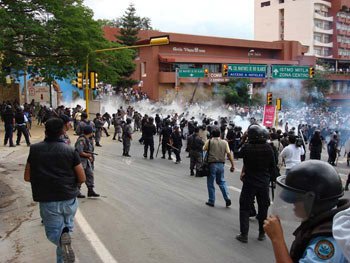
The confrontations then began. Niños Heroes Avenue runs an east-west circle, Crespo and Joaquin Amaro go north-south. Standing on Crespo it was possible to see a bus burst into flames on Niños Heroes, to see the clouds of tear gas, to watch the small barricade under construction nearly at my feet, and the riot police stationed one block west at another access to the hill. Youngsters with their faces covered against the teargas were picking up canisters and hurling them, uselessly, back uphill at the police. Others broke up the pavement for stones to throw.

Amid this scene one woman teacher exhorted the fighters to go back to the Plaza de la Danza to regroup. It was not possible from the Crespo vantage point to see where the Guelaguetza delegation had gone. One block east on Joaquin Amaro, the mayhem repeated: tear gas and people running to escape, and others running back toward Niños Heroes. It seemed to me that the streets were filled with people racing in all directions.

According to La Jornada’s electronic edition, at least 40 persons were injured, 20 police were wounded, and some other number were arrested. At least four public transport buses were set on fire, and businesses near Hotel Fortin Plaza were damaged, as was the restaurant of the Hotel. Guests at Hotel Fortin and Victoria Hotel fled the gas.

By the time I returned to Crespo more than an hour later, the military vehicles and ambulances were moving north toward Niños Heroes and the APPO contingent was running south. Various people told me urgently to go home, to get off the street.

A Civil Society bulletin reported that at 11:30 AM elements of the Municipal Police, the Preventive Police and the Bank and Industrial Police confronted, with tear gas and stones, the marchers of the APPO and teachers of Section 22 of the National Education Workers Union as they tried to climb to the Guelaguetza Auditorium.

According to that report, the various police units brutally beat teachers and protesters, in addition to launching teargas against commercial establishments, private homes and public buildings. The violent escalation resulted in wounding photographers from Reforma, Noticias, Marca and Tiempo, who were covering the “ferocious blow” by the police against the protesters.

This violence was coordinated by the Secretary for Citizen Protection to impede the celebration of the Popular Guelaguetza, although several days ago the Government of the State declared it would respect the event. “This is a government incapable of dialogue which resorts once again to the irrational use of Public Forces,” the reports states.

By 1:30 the APPO, as far as I could see, had given up the fight, after a struggle of four hours. I saw the tear gas and its effects; I did not see the wounded although we heard the ambulance sirens. I saw men on Niños Heroes throwing projectiles, too far away for me to identify what they threw. I saw the flames and black smoke of the bus.

On Sunday morning the headlines in Las Noticias had forewarned that the Cerro de Fortin, Fortin Hill and the Guelaguetza auditorium on it, would be held by police and military, to prevent its use by the Popular Guelaguetza. The reasons given: 1) The people have no government permission to use the auditorium; 2) the event might make an opportunity for guerrillas of the EPR to blow up this “strategic” site.

Other possible reasons, as I speculate: 1) Spite. If the teachers blockade the commercial Guelaguetza this is what they’ll get!; 2) Stupidity, because the provocation now achieved can not serve the governor. (If I was there taking photos, you can bet photos are now out all over the globe. Even his supporters now proclaim, “Welcome Tourists to the Oaxaca inferno!”)

Faced with the governor’s proclamation, Section 22 and APPO spokespersons announced that the Popular Guelaguetza would move to Plaza del la Danza, to avoid provocation and a blood bath.

Having just read the movement decision to go elsewhere, on Crespo at 3:00 on Sunday I passed the armed state police (blue uniforms) standing on the side walk with their automatic weapons. Guarding the stairway up the hill the troops wore helmets, shield, and canister belts. Police vans lined the street.

Then, at Carmen Alto Plazuela, the delegations gathered for the official opening of the Popular Guelaguetza. The host identified himself to me as Roberto Matadamas, an official of the Section 22 Cultural Committee. I asked him to identify himself because he explained to the crowd at the plazuela the history of the Guelaguetza, and what it means; then he said, “We are peaceful people and we have struggled without arms for years… Our customs cannot be used for commercial purposes…. this governor has a very small brain… we are going to the Cerro de Fortin over the bodies of the police.”

This game of cat and mouse moved around, because after the show of military at the Fortin stairway starting on Friday, the military subsequently disappeared, then reappeared; Monday morning they stood higher up, where they blocked access to the auditorium and the plaza of the auditorium. But while APPO and Section 22 had decided to move the Popular Guelaguetza to Plaza de la Danza, the more furious members of both organizations had decided to confront the government forces.

The parade (calenda) on Sunday included about two thousand marchers, and apparently thousands more lined the three-hour route through the several neighborhoods (colonias). The calendas have been well-guarded by identified APPO men running alongside. I went home with the words of Matadamas churning in my stomach.

Let me back up to discuss the weekend events:

A small table is set up in the Alameda across from the catedrál where people can sign up for the Asamblea Popular de Colonias de Oaxaca (APCO). I stopped to chat for a minute on Friday afternoon of the 13th and was told that up to then, 71 colonias had sent a representative. I asked how may colonias Oaxaca has more than 200, my informant claimed. (The ultimate word I received from the municipal president pre-candidate Victor Raúl Martinez Vasquez: 271 includes colonias and fraccionamientos (private enclaves, often gated). He’s out there campaigning; that’s how he knows.)

By that tally, perhaps one third of the city has enrolled a delegate. Some colonias have only one person, who may hope for a position in a future administration and who represents only himself. Others may be more lively. In either case, 500 persons marched who were not afraid, and a new asamblea was formed.

That first APCO march took place on Friday, July 13. The route crossed from the Monument to Mothers to the zócalo, arriving at the center at six or seven o’clock, depending on who you asked. (I’m getting better at translating times –”natural”; or “government” or “neoliberal”: daylight savings.)

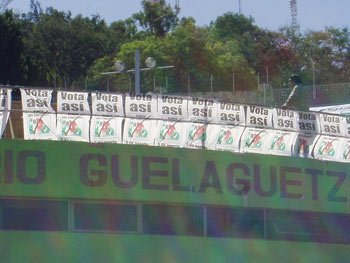
That same day (it’s still Friday) on my way down to see the colonists enter the zócalo, I passed the stairs to Fortin. Buses jammed the street, men lingered on the stairs looking smug in clean white shirts, and along the sidewalk hurried many people whose faces showed the grim look I associate with getting to work on time. Nobody looked to me like they were voluntarily headed to a fun event –no exhilaration, no smiles. Buses hauled in thousands of campesinos from rural areas. Noticias reported traffic jams. One of the men on the stairs told me the event was a PRI rally. Posters showed bigger than life-size ballots, with an appropriate check-mark next to “PRI.”

When I arrived in the zócalo two small calendas (parades with puppets) for some candidate-or-other danced around, and then the five hundred APCO people finally arrived. By then it was 6:30. They strung their banners and began their presentation. The crowd listening brought the total to about seven hundred, my guess. The speeches focused on the prisoners, with two huge photos of the EPR men who vanished in May. The wife of Flavio Sosa, and a daughter of a disappeared EPR man addressed the crowd, and others spoke of specific people still in jail. I was disappointed that nobody spoke to broken sidewalks, potholes, unfinished projects or dirty intermittent water. In other words, as a city organization, it hasn’t yet organized around city issues. But I’m hopeful.

A fellow-listener told me that people he knows remain fearful after the November repression, and won’t march or attend APPO events. He and several others agreed that the people up at the PRI rally were paid or obliged by their jobs, to come. He himself won’t speak to anyone he doesn’t know. He whispered, “There are many closet APPO.” I laughed, but it isn’t funny.

One thing was clear: those in the zócalo were the pueblo, those at Fortin were the prisoners of Ulises Ruiz. The zócalo restaurants filled up later, and business was good – the PRI have to eat, too.

Saturday

The calenda began in Plazuela Carmen Alto with guys appearing out of nowhere. They ran cables. They carried onto the plaza huge loudspeakers which, with one guy on each handle, were hoisted onto stands. Someone appeared with a microphone. Finally the Juchitán dancers appeared in their costumes, accompanied by the Juchitán band. The announcer explained the popular free Guelaguetza: “Guelaguetza means reciprocal giving. The people give to the government but the people have not received anything in return. So now we give directly to the people.”

After one dance on the plazuela, the calenda assembled with a huge truck leading the way. I counted two dozen security guys wearing visible tags around their necks, who ran in front of and beside the calenda while it danced along for nearly three hours through various colonias. The “cultural events” which followed in the zócalo were attended by several thousands – fireworks, the kind with the bamboo tubes shooting sparks while a person underneath the armature runs around; and the kind shot up into the sky that go Boom. Then the main feature, a dramatic presentation by “Arte en Resistencia” on the kiosko, which was strung with see-through wires. Their title is “Oaxaca is not celebrating, it is mourning” for the dead and disappeared. A Mexican wake. My translation of their flyer:

Dear Tourist: Oaxaca is not celebrating…It is mourning. This is a performance and installation which brings together different disciplines, (musicians, dancers, plastic artists and performers) committed to the social and political moment in Oaxaca.

We are not celebrating nor will we, while justice is not given in our state, nor punishment to the assassins of our companions fallen this past year, nor freedom for prisoners who are still in federal and state jails, nor cancellation of orders for arrest nor a halt to the atmosphere of police and military hostilities on the part of the Governor Ulises Ruiz.

Also, it is important to recover what is ours, as is the case with the Guelaguetza, a traditional festival of the people of Oaxaca, presently converted into a private event by the state and losing its original meaning, since the government has sought to emphasize only tourist and commercial needs, at the expense of our people and tradition.

Another major error is that being a celebration of our diversity, the Guelaguetza is now monopolized and centralized, benefiting the same people year after year, that is to say, the politicians and the merchants, since the Oaxaqueños each year are more alienated and they only receive crumbs. It is directed more than anything else to the visitor, which matters only as the economic levy it represents.

It is time to take back what is ours, the most important Oaxaqueña festival of the year, which supposedly gives us identity, unity and a reason to come together culturally, socially and economically. The Guelaguetza can not be reduced to a colorful and attractive tourist business since it already holds for the Oaxaqueños a feeling, a profound sentiment, which should be guarded, in addition to increasing the accords of our present society, to the end of changing it into the most important social cohesion of our pluri-cultural society.

The Guelaguetza should be the common forum for a true interchange, approach, involvement and contact among the peoples, a point of encounter and access to the different customs and values of each place, a cultural, economic, political and social window, to embrace a broad aspect not only of its fiestas and customs but also to take advantage of this forum to discuss matters of common interest, as it can further the use of social currency through our old legacy, the barter, which opens new possibilities for producers, artisans and campesinos; among many other activities which it could implement. That way citizen participation will become important through discussion forums.

Summary:

  • In case you wonder why the government might not want a popular guelaguetza, the final paragraph by Arte en Resistencia explains it very well.
  • Friday a new asamblea made its debut. Two dozen armed state police remained on Fortin after a PRI rally, along with a few men in military khakis. An APPO member said it was just to intimidate.
  • Saturday’s Noticias proclaimed: the government forbids use of the people’s space.
  • Saturday and Sunday, traditional events passed with happy participation.
  • Monday on the Hill, Lunes Del Cerro, some people once again burst with rage when they were prevented from entering the Guelaguetza area. Thousands of others went to Plaza de la Danza, for the second free year of the Oaxaca Popular Guelaguetza.
  • Next week the commercial Guelaguetza is scheduled on the hill. An APPO-teachers boycott was proclaimed but details of it remain unknown.

Narco News: Oaxaca Government Armed Forces Use Violence to Prevent the People's Use of the Guelaguetza Auditorium