What is the way out?
Assabah Khan, 28.8.2008
Indian Administered Kashmir is back in news. This time the reason is Kashmiris are protesting against transferring of 40 acres of land to non- state subjects. Why are Kashmiris so suspicious about transferring of this land? Mr. Umar Abdullah President of National Conference read out the statute 9 of land transfer order to public in a TV show hosted by take 1 Television. This statute allows the parties taking possession to construct railway lines and public transport system on the acquired land. People are questioning how come a government is going to lay railway line for 3 months and take it off for 9months? When the pilgrims are free to move the whole of Kashmir why are they wanting to have separate public transport system? These are some of the questions which makes this whole order suspicious. Tremendous public reaction and a strike for ten days enforced the state government to revoke the order. I was in England
for ESF 2004 and we met a person named Jeff Hurd. Jeff is a Jew working for Israeli Committee Against Demolition of Palestinian Homes (ICHAD). Jeff told me if I ever visited Israel he will familiarize me with a concept called 'Metrics of Control'. I couldn't understand
what he meant by this? He said this is how Israeli government is creating pockets of Jewish settlements and thus uprooted the Palestinians. He even told me that I should tell my people to be careful as Israeli Intelligence agencies are sharing information with Indian Intelligence agencies to create the same Metrics of Control in Kashmir. In my mind I dismissed this whole argument as absurd and I even forgot I had ever met this man. This year when I saw many Kashmiris talking about creation of Israeli type settlements I was reminded of Jeff. Is Government of India really trying to change the demography of the state is an issue of debate?
Jammuites came out on the streets against the revocation of land order. They blocked the national highway Kashmir's only link to outside world. Kashmiri drivers are attacked with petrol bombs. As more and more Kashmiri drivers started pouring in narrating horror tales of attacks by Hindu rightwing people the situation in valley started worsening with shortage of supplies like food, medicines, petrol and other daily commodities. On 11th August, 2008 fruit traders association gave a call of Muzaffarabad march and threatened the government with crossing the Line of Control as their fruit woth billions of rupees started rotting as a result of economic blockade.
Pro- freedom leaders and even Peoples Democratic Party PDP decided to support the call. Almost 6 people died the same day including Sheikh Abdul Aziz a pro-freedom leader.Next day on 12th August almost 12 people died. 10 died in the valley and two in Kashtawar district of
Jammu. All these people died as a result of firing by Indian troops on unarmed civilians who were protesting against economic blockade.
Next day on 13th, pitched battles could be seen between troops and Kashmiri people as a result killing almost 10 people and many were critically injured. What was shocking for the Indian authorities was not the killings but the amount of people who poured out on the streets during Muzaffrabad march. So far government of India was misleading the national and international public that Kashmir is a problem of cross border terrorism but all of a sudden it was faced with a sea of unarmed civilians not only demanding opening up of Muzaffarabad road but freedom of Kashmir. They were carrying no arms and they carried peaceful rallies and government could not find any excuse to justify excessive use of force. With the death toll rising to 40 with many critically wounded not sustaining the injuries the whole valley was wrapped in rage and sorrow and Kashmiris feeling that last shred of trust with Indian state was torn.
Unending sea of people shouting pro- freedom and anti-India slogans which turned on the roads during March to UN office on 18th August, 2008 almost made the government of India feel crazy. It was almost a mandate from the people of Kashmir that they no more want Indian rule
in Kashmir. Highly placed sources told this writer that Initially government agencies had decided not to allow the march to UN but at 11:00 PM at night Indian Intelligence People gave in the inputs that government should allow the rally to go ahead and they are going to achieve something big next day. As highly placed sources quoted that the main objective was to break the coalition. Many rumours about breaking of coalition were spread including that Mirwaiz Umar mightnot turn up at Eidgah rally. But on 22 August, 2008 when again a whole sea of people turned up and no break in coalition could be achieved government decided not to allow march to Lal Chowk. Curfew was imposed in valley. According to Hindu Indian national newspaper 13 journalists were beaten, curfew passes were dishonored, local TV channels were banned. So, is this repression going to serve the purpose of government of India or are Kashmiris going to internalize all their suffering till it ignites again and erupts again in more intense manner.
The best solution would be to open all the trade routes to Jammu and Kashmir, initiate a dialogue process with the government of Pakistan without any delaying tactics, have some kind of joint control of the region and have maximum sovereignty for the valley.
http://womenbetweenthefrontlines.wordpress.com/
Read also:
Azadi It's the only thing the Kashmiri wants. Denial is delusion.
Tuesday, September 02, 2008


Defend RNC Protesters in St. Paul!
Take Action to Defend RNC Protesters!
Stop the Police Riot in St. Paul!
Although it went virtually unmentioned in the corporate media, on Sept. 1, the largest anti-war march of 2008 took place outside the Republican National Convention in Minnesota. 30,000 people from all over the Midwest and the country gathered at the Minnesota State Capitol in St. Paul and them marched to the Xcel Center, the site of the RNC. Large numbers of buses came from all over Illinois, Wisconsin, and the surrounding states.
 Michael Prysner, speaking in St. Paul |
Among the many speakers at the Minnesota State Capitol, where the march gathered, was Michael Prysner, an Iraq war veteran who represented the ANSWER Coalition. Mike addressed the crowd, "I was sent to Iraq in 2003 not to save the Iraqi people, but to kill the Iraqi people. I was sent not to free the Iraqi people, but to imprison and torture the Iraqi people. I was sent not to liberate Iraq, but to occupy Iraq. There is no longer any question that this war was not for so-called “Iraqi freedom”, it was not an act of self-defense, and it was not simply a foreign policy error by the republican party- it was a well-calculated plan carried out by both parties to dominate the Middle East, killing as many innocent people as necessary and profiting from that human suffering."
Send a Letter Demanding the St. Paul Government Release All Protesters!
The police have engaged in a widespread riot against social justice organizations, resulting in the arrest of around 300 protesters. Most of the arrested are still in jail, and at least one person with a serious medical condition has been refused care.
Even before the Convention began, protesters had the organizing centers raided. Armed groups of police in the Twin Cities have raided more than half-a-dozen locations since Friday night in a series of “preemptive raids." The raids and detentions have targeted activists planning to protest the convention, including journalists and videographers from I-Witness Video and the Glass Bead Collective. These media organizations were targeted because of the instrumental role they played in documenting police abuses the 2004 RNC Convention. Their comprehensive video coverage helped more than 400 wrongfully arrested people get their charges thrown out.
Democracy Now! producers Sharif Abdel Kouddous and Nicole Salazar -- who clearly identified themselves as members of the media -- were arrested, and could face suspicion of rioting charges, a felony. When Amy Goodman, host of Democracy Now! went to the scene to inquire with a police commander about the arrest of her producers, she too was arrested. A CodePink march and several breakaway marches were also met with police repression. Tear gas and concussion grenades have been used to disperse crowds.
There is an undeniable pattern of police repression at these conventions. In 2004, 1500 protesters were arrested at the RNC. Subsequent litigation on behalf of the protesters revealed that national and local enforcement conspired to deny protesters their civil liberties and civil rights. Protesters were held in miserable conditions, and only mass pressure forced the police to release them.
Please take a moment and click this link to send a letter to Chris Coleman, the mayor of St. Paul, demanding that all protesters and social justice organizers be released, and that all charged be dropped. The real criminals are the "law enforcement" authorities, who have systematically violated the free speech rights of protesters, and in more than a few cases carried out physical abuse.
This report was filed with information provided by John Beacham of the ANSWER Coalition.
A.N.S.W.E.R. Coalition
http://www.answercoalition.org/
info@internationalanswer.org
National Office in Washington DC: 202-544-3389
New York City: 212-694-8720
Los Angeles: 213-251-1025
San Francisco: 415-821-6545
Chicago: 773-463-0311
Saturday, August 30, 2008
Video about the making of Bolivia's new constitution (Spanish)
And report about the fascist movilizations in Media Luna (Santa Cruz, Beni, Pando, Tarija), the separatists struggle for what they call autonomy...
A continuación un video que esta circulando por Internet:
A continuación un video que esta circulando por Internet:
Haz click en cualquier video para verlo
Puedes ver otros en radiomundial.com.ve
Puedes ver otros en radiomundial.com.ve
Sunday, August 17, 2008
Hunger strike in Campsfield as deportee takes his own life in Iraq
Some 50 refugees held at Campsfield immigration prison, near Oxford, are on hunger strike in protest at their continued detention. The hunger strike was started on August 9th by 13 Iraqi-Kurdish detainees, who demanded that forcible deportations to Northern Iraq are stopped. This is the second such protest at Campsfield this year and one of many throughout the UK detention estate.
Meanwhile, an Iraqi-Kurdish refugee has taken his own life after being forcibly returned to Iraqi Kurdistan. Hussein Ali shot himself in his home in Sulaimania on August 10th, two days after he was deported to Erbil via Jordan. An emergency demonstration in support of the hunger strikers, called by the Campaign to Close Campsfield, was held outside the immigration prison on August 12th.
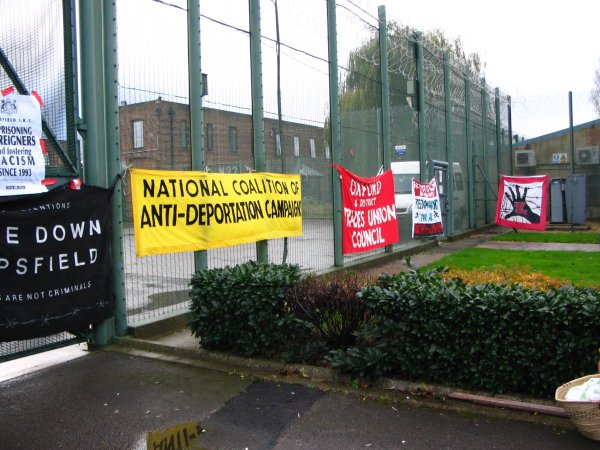
banners on the razorwire fence
On August 9th, campaigners received reports from detainees inside Campsfield saying that 13 Iraqi-Kurdish asylum seekers detained at Campsfield immigration prison are refusing food in protest at their continuing detention and demanding that forcible deportations to Iraqi Kurdistan (northern Iraq) are stopped. Later reports confirmed that some 50 other Campsfield detainees from around the world have joined the hunger strike. A message from the hunger strikers read:
"We are protest[ing] because we are human beings; we are not criminal. We are locked in the cell like prisoners. We want freedom and justice."
The UK is one off the few European countries to forcibly 'remove' asylum seekers to Iraq. In 2005, an agreement was reportedly signed between the Iraqi Government, the Kurdish Regional Government and the UK Home Office to accept forcibly returned asylum seekers. Since then, over 500 rejected asylum seekers have been deported to Iraqi Kurdistan on special charter flights.
The argument the Home Office has used to deport Iraqi-Kurdish asylum seekers to Kurdistan (northern Iraq) is that the northern parts of the country, unlike the rest, are "relatively safe". This is, of course, totally unfounded. In its position paper on Iraq, UNHCR recently said that the security situation in the three northern governorates (Sulaymaniyah, Erbil and Duhok), "remains tense and unpredictable" and that "careful consideration" must be given before any returns are carried out.
Who's responsible?
A day after the hunger strike started, an Iraqi-Kurdish asylum seeker, who was forcibly removed to Northern Iraq after 50 days in detention, took his own life. The International Federation of Iraqi Refugees (IFIR) was told by a detainee in Oakington detention centre that his friend, Hussein Ali, shot himself in his home in Sulaimania on August 10th, two days after he was deported to Erbil via Jordan.
Hussein Ali was 35 years old. He had arrived in the UK six years earlier but his asylum claim was rejected. Whilst in detention, he wrote many letters to the Home Office asking to remain in the UK but all fell on deaf ears.
This is the second this year suicide by Iraqi-Kurdish refugees on return from the UK. The other man, known as Heman, hanged himself from a tree shortly after return. Another Iraqi-Kurdish refugee, Kadir Salih, was kidnapped last month in front of his house in an area controled of Patriotic of Union Kurdistan party shortly after returning home. His daughter was so distressed at his disappearance that she committed suicide. After five years of fighting for asylum and not being able to work, Kadir had given up and signed on the IOM's 'voluntary return' scheme.
Another Iraqi refugee died from cancer on August 3rd. Mohammad Hussain had stomach cancer that went undetected and untreated while he was detained in Lindholme immigration prison near Doncaster (see here for more details).
Meanwhile, Iranian refugee Nadir Zarebee hanged himself in a Manchester park on August 5th after being asked to leave his home in Trafford by his private asylum accommodation providers, MNQ. An emergency protest was called last on August 9th by the International Organisation of Iranian Refugees (IOIR) and supported by the North West Asylum Seekers Defence Group (NWASDG) and Fight Racism! Fight Imperialism! (FRFI). Protesters gathered in Piccadilly Gardens and then marched to the BBC offices, who protesters said censor the "racist treatment and brutal human rights abuses of migrants and refugees."
4.08.2008 21:51
The hunger strikers remain resolute in their determination to continue with their struggle. They are all very concerned about the deaths of those who have recently been returned to Iraqi/Kurdistan and are determined that they will not follow them.
Hata Najem has been given a date to travel on 3/9/08. He has been in the UK for 8
years.
Ali Ahmed Hassan is reported to now be very sick, but has apparently only seen the doctor once.
The treatment all the men are receiving is described as poor. Fazzel has said that one guard in particular, * ******, has been verbally abusive to the detainees, telling them that he's happy they're not eating as it's a saving to the taxpayer and giving detainees quite graphic descriptions of what he would like to do to them if there were no CCTV in the centre.
Mr. ****** has also been alleged to have physically pushed detainees and verbally abused them for requesting guards' ID details.
The general disrespectful attitude of the staff is described as central to the detainees' decision to go on hunger strike and Fazzel describes, for example, a customary practice of detainees' meals being kicked across the floor to them by guards, rather than passed by hand.
Fazzel also claims that a proposed BBC local radio interview was blocked by Campsfield management this morning; he claims that the reporter has been given misleading information to the effect that the detainees have criminal convictions. They do not.
One detainee managed to get on to the roof of Campsfield IRC yesterday but came down after a number of hours. He is now in the Health Care unit at the detention centre.
Spokesperson for the Kurdish hunger strikers Fazzel Abdul said: "Without any reason we are being held here and they are trying to deport us to the most dangerous country in the world. We want people to listen to us. We are refusing all food and water and we will keep going. It is better to be dead than to return to Iraq."
Hata Najem has been given a date to travel on 3/9/08. He has been in the UK for 8
years.
Ali Ahmed Hassan is reported to now be very sick, but has apparently only seen the doctor once.
The treatment all the men are receiving is described as poor. Fazzel has said that one guard in particular, * ******, has been verbally abusive to the detainees, telling them that he's happy they're not eating as it's a saving to the taxpayer and giving detainees quite graphic descriptions of what he would like to do to them if there were no CCTV in the centre.
Mr. ****** has also been alleged to have physically pushed detainees and verbally abused them for requesting guards' ID details.
The general disrespectful attitude of the staff is described as central to the detainees' decision to go on hunger strike and Fazzel describes, for example, a customary practice of detainees' meals being kicked across the floor to them by guards, rather than passed by hand.
Fazzel also claims that a proposed BBC local radio interview was blocked by Campsfield management this morning; he claims that the reporter has been given misleading information to the effect that the detainees have criminal convictions. They do not.
15.08.2008 16:08
Speaking to some of the detainees at midday today, they were all resolute to continue refusing food, until their basic demands are met: released from detention and to be recognised as refugees.One detainee managed to get on to the roof of Campsfield IRC yesterday but came down after a number of hours. He is now in the Health Care unit at the detention centre.
Spokesperson for the Kurdish hunger strikers Fazzel Abdul said: "Without any reason we are being held here and they are trying to deport us to the most dangerous country in the world. We want people to listen to us. We are refusing all food and water and we will keep going. It is better to be dead than to return to Iraq."
Reports: Campsfield detainees on hunger strike | Unacceptable death of Hussein Ali | Two more deaths of asylum seekers
Related: Riot at Campsfield Detention Centre | 26 migrants escape immigration prison in Oxford | Detained Mothers on Hunger Strike in Yarl's Wood | Once again, Harmondsworth hunger strike broken violently | Dozens of Iraqi Kurds deported.. again
Links: National Coalition of Anti-Deportation Campaigs | Campaign to Close Campsfield | International Federation of Iraqi Refugees | Coalition to Stop Deportations to Iraq | No Borders UK
Tuesday, August 12, 2008
Bolivian Referendum Results Analysis
By Andrew Lyubarsky
August 12, 2008 | Posted in IndyBlogBolivia
August 12, 2008 | Posted in IndyBlog
For the Movimiento a Socialismo and Evo Morales, Sunday was indubitably a good day. After having won the Bolivian presidency in 2005 with approximately 54% of the popular vote, Evo surprised everyone by not only winning the recall referendum convoked by the right-wing opposition, but by winning big, with over 62% of the vote. Commentators that had lamented Evo’s loss of support by his “frightening of the middle class” and “loss of the urban vote” were left surprised that Evo was able to not only consolidate his support in rural Bolivia to near unanimity, but make substantial inroads in urban centers such as Cochabamba, in which vocal anti-Morales sentiment is frequently heard. He even captured about 40% of the vote in
It is extremely likely that, as he announced in his victory speech, Evo will use this as a mandate to push more aggressively for his project of social transformation – a new, indigenous-centered constitution, nationalization of formerly-privatized industries, and a pursuit of land reform in
Government Support in Autonomist Regions Surprisingly High
Looking at the bright side, Evo’s roughly 40% approval in the autonomist states suggests that the opposition to his government voiced by regional leaders and the press does not represent significant sectors of society in the so-called “Media Luna” of opposition. Despite the radical opposition voiced to his government in his two years in power, this percentage actually represents an increase over the level of support he got there in 2005. However, his 60% disapproval there, along with the easy margins of victory for the opposition governors, suggests that the application of any kind of assertive policy that affects elite interests will be bitterly contested. While the right-wing is likely to wince at the magnitude of Evo’s victory and some of its ideologists may have held millenarian ideas of recalling him and restoring the order that had been broken by the “
After the discrediting of neoliberal economic policy and the growing assertiveness of indigenous movements in the 1990s, the Bolivian right wing and traditional political structure realized that it had to prepare to lose hegemonic control over the national government. They were a predominantly white minority in a society still rife with colonial elements and an ideology of racial distinction, and a minority whose ideas of development and Bolivian society had long failed to resonate with the predominantly indigenous population. Thus, instead of waging the losing battle of contesting national control, they undertook, quite successfully, a project of regional consolidation in
The results of the referendum confirm this struggle for them, and they will continue unabated in their confrontational discourse. It is likely that despite winning a level of support unheard of for a Bolivian president in the democratic era, Evo will still be unable to visit 5 out of the country’s 9 states unless he is willing to use force to subdue violent right-wing youth groups, actions which could spark a wider conflagration. The tone of his latest speech was conciliatory to the victorious opposition prefects and called for dialogue, but as it becomes increasingly clear that they will agree only to a dialogue that preserves their rights to rule the East as their private fiefdoms, the government may have to become more aggressive.
The most proximate struggle will be over the blowout loss of Manfred Reyes Villa in
In January 2007, MAS tried to force Manfred to resign, angered after he attempted to call a second autonomy referendum after the question had already once been defeated in the state. They occupied the central square, and Manfred-sponsored goons from the upper-middle class areas of the cities descended on them, eager to “beat up some Indians”. Two MAS backers from rural areas and one upper-middle class teenager were killed in the conflict, the state building was briefly set on fire, and Manfred came off as the defender of democracy against an unruly mob.
This time, the democracy card is on the side of MAS. The question of the day is whether the right-wing opposition will circle its wagons to defend its ally in
Dialogue or Confrontation?
The rhetoric of the mainstream political commentators in
Friday, August 08, 2008
New developments in ongoing railroad of Mumia Abu-Jamal

The following is reprinted from the 3 August 2008 issue of Revolution, voice of the revolutionary Communist Party, USA (revcom.us)
At every point in the tortuous case of framed former Black Panther and journalist Mumia Abu-Jamal, he has been denied the most basic legal rights supposedly afforded to all those brought before the courts. This is one reason why his case so highlights the nature of the oppression of Black people and the fundamental nature of the "justice" system under the dictatorship of the capitalist class.
On 22 July, ten judges of the U.S. Third Circuit Court of Appeals dismissed without comment the request by Mumia Abu-Jamal for a rehearing of his federal appeal before a panel of all the judges of the circuit. Mumia's appeal had been rejected in May this year in a two-to-one vote by a three-judge panel reviewing the case.
This decision continues the 27-year railroad of a Black revolutionary writer and activist, framed by the infamous racist court system of Philadelphia. Mumia Abu-Jamal has been held in isolation on Pennsylvania's death row since his 1982 trial that was a travesty of justice.
This has occurred in spite of the mountain of new evidence that has been developed since Mumia's original trial in 1983, where Mumia was denied the right to represent himself and was barred from the courtroom during most of his own trial for protesting this injustice.
For example, recently discovered photographs by a freelance photographer, who stumbled upon the scene just after the shooting of a police officer for which Mumia was convicted, show that police rearranged the evidence at the scene and there are no marks on the sidewalk where Mumia allegedly repeatedly fired down at the fallen officer.
But, as the U.S. Supreme Court has pointed out, the federal courts are not in the business of correcting bogus prosecutions and convictions; they content themselves with protecting federally guaranteed procedural rights. In fact, the Supreme Court has actually stated that it is legal for a state to execute an innocent person as long as correct procedures were followed!
Yet for all their interest "protecting procedural rights", the recent Third Circuit Court decision had to ignore its own precedents where it has repeatedly overturned convictions for exactly the same reasons raised in Mumia's case.
In a spirited dissent to the earlier May ruling, Judge Thomas L. Ambro reviewed similar cases in which the Third Circuit had granted a new trial for reasons of racist jury selection and then remarked that "I see no reason why we should not afford Abu-Jamal the courtesy of our precedents."
No matter how much new evidence is brought to light, Mumia will not get another chance to present it in federal court unless his current appeal succeeds. Under the Anti-Terrorism and Effective Death Penalty Act of 1996, signed into law by President Bill Clinton, each criminal defendant can apply one time and one time only to the federal courts. Mumia's attorney announced he will now appeal to the U.S. Supreme Court, but the Supreme Court accepts very few such cases.
The Third Circuit appeals court did uphold a federal district court ruling which threw out Mumia's death sentence because of misleading instructions to the jury. But in the event that the U.S. Supreme Court fails to grant Mumia a new trial, the state of Pennsylvania is free to convene a new jury to do the sentencing phase of his original trial all over again. That is, the state will get yet another shot at sentencing Mumia to death
Friday, August 01, 2008
Oury Jalloh Initiative “Out of the Court – Back on the Street!”
Initiative in Gedenken an Oury Jalloh - Who was burned to death in the
Dessau Police Station Cell on the 7th of January in 2005
BREAK THE SILENCE!
TRUTH! JUSTICE! REPARATIONS!
Berlin – July 28, 2008
Press Release
Under the motto “Out of the Court – Back on the Street!” the Initiative in Memory of Oury Jalloh is calling for a nationwide demonstration to be held in Dessau on August 2, 2008. The demonstration will begin at the central train station at 1 p.m. The motive of the demonstration is to denounce the most recent scandalous developments in the case of Oury Jalloh.
The following is the respective declaration of the Initiative in Memory of Oury Jalloh:
How many scandals are necessary in order to scandalize a scandal? How insignificant is the death of a Black man at the hands of the police and their subsequent bold-faced attempts to conceal the truth to the society as a whole and the press in particular? How many lies, cover-ups,
contradictions and persecutions are necessary in order for the silence to be broken?
After having struggled – and succeeded – to force a trial for the death of Oury Jalloh, in June of this year the initiative founded in memory of the murdered African refugee has withdrawn from observing the proceedings following 15 months and 43 hearings of systematic lies and cover-up.
Why?
Practically all of the evidence presented until this moment contradicts everything the police have claimed until now. From the detention itself to the conditions of his being brought into the police station, from the mysterious lighter to the fireproof mattress, from the disappeared and
tampered with evidence to the contradiction between the reconstructions of the fire and the extremely charcoaled state of Oury Jalloh’s corpse, the entire body of witness testimony stands in direct contradiction of the thesis put forth by the police through internal bulletins and subsequently taken up by the State Prosecutor immediately following the burning to
death of a human being chained at his hands and feet to a fireproof mattress in a holding cell of the police: Oury Jalloh set himself afire (i.e. suicide). “All these is horrendous and brutal”, say Mouctar Bar, the founder of the Initiative.
In spite of all these pieces of evidence which clearly indicate that a serious crime is being covered up on the part of the police, in the trial in Dessau against two police officers for negligence and having overlooked a lighter, respectively, the District Court of Dessau led by Judge
Steinhoff continues to ignore and marginalize ab absurdum any other factor not directly related to the approximately six minute time frame which the main accused Schubert is said to have had to save Oury Jalloh’s life.
The fact that no one could hear the screams of a man being burned to death, the testimony of police officer Kiez, the fire specialist from Magdeburg with 27 years of experience who “found” the lighter, the fact that Oury Jalloh had his pants down to his thighs, that an unexplained
puddle of liquid was seen in the middle of the cell by numerous witnesses, the contradictory statements by the two detaining police officers as to their location at the time of the crime, the broken nose, burnt off fingers and damaged eardrum, the extreme charcoaled state of the corpse, the disappeared video and handcuffs, the revealing testimony of Swen Ennulat, the shocking reconstruction of the fire and, perhaps more importantly, how the fire broke out in the first place, all are considered by all parties involved in these hearings to be irrelevant to the trial
itself.
As the people who have faced the trauma associated with confronting such a horrendous death in custody day in day out for over 3 ½ years, as the people whose sweat, tears and sacrifice have forced a trial which otherwise would have and still probably will end in impunity, as many of
the same people who have faced direct police brutality based on the color of our skin, in the face of such an appalling affront to the rule of law we have seen ourselves forced to withdraw from the trial in protest.
In spite of the fact that for years the authorities have done everything in their power to criminalize us, to impede our freedom of speech, to present us as violent offenders whose identification papers have to be constantly searched alongside our bodies, in spite of the criminal
persecution against Mouctar Bah, the friend of Oury Jalloh and his family’s representative here in Germany, in spite of the constant lies and cover-ups, in spite of being angry and desperate for the truth, we have respected the authority of the court and have passively watched yet
another display of arrogance and systematic contempt not only of the court itself but first and foremost of the now deceased Oury Jalloh and all of us who identify with him.
But we shall no longer serve as the legitimation for their show trial nor shall we will remain passive in light of such continued abuses. As such, we will take back the streets which helped us force the trial in the first place. As we have repeatedly shown over the course of these last 44
months, we will break the silence and we will continue our struggle to see that the only wish which can now remain for the Jalloh family of their son be fulfilled: to know the truth about how and why their son had to die.
“We see this case as having something to do with murder which the state is trying to cover-up and society turns a deaf ear and a blind eye but, we shall be relentless and steadfast”, emphasized Mouctar Bah again.
In addition, we shall do everything in our power to see that through our struggle we not only break the silence of a complicit society in the case of Oury Jalloh, but also that the many other numerous cases of police brutality and sometimes even murder, like that of Dominique Koumadio, Laye-Alama Konde and John Achidi, to name just a few, are exposed and justice is done.
For more information please see our contact information listed above.
BREAK THE SILENCE!
TRUTH! JUSTICE! REPARATIONS!
Information und Mobilisierungsvideo mit Mumia Abu Jamal
http://thevoiceforum.org/node/892
Pressemitteilung: Gerichtsprozess im Fall Oury Jalloh eine Farce
http://thevoiceforum.org/node/893
Reports in racist police brutality
http://thecaravan.org/taxonomy/term/28
E-MAIL: initiative-ouryjalloh(at)so36.net / Mobil: +49 (0)170-8788124
Internet: http://initiativeouryjalloh.wordpress.com/
Dessau Police Station Cell on the 7th of January in 2005
BREAK THE SILENCE!
TRUTH! JUSTICE! REPARATIONS!
Berlin – July 28, 2008
Press Release
Under the motto “Out of the Court – Back on the Street!” the Initiative in Memory of Oury Jalloh is calling for a nationwide demonstration to be held in Dessau on August 2, 2008. The demonstration will begin at the central train station at 1 p.m. The motive of the demonstration is to denounce the most recent scandalous developments in the case of Oury Jalloh.
The following is the respective declaration of the Initiative in Memory of Oury Jalloh:
How many scandals are necessary in order to scandalize a scandal? How insignificant is the death of a Black man at the hands of the police and their subsequent bold-faced attempts to conceal the truth to the society as a whole and the press in particular? How many lies, cover-ups,
contradictions and persecutions are necessary in order for the silence to be broken?
After having struggled – and succeeded – to force a trial for the death of Oury Jalloh, in June of this year the initiative founded in memory of the murdered African refugee has withdrawn from observing the proceedings following 15 months and 43 hearings of systematic lies and cover-up.
Why?
Practically all of the evidence presented until this moment contradicts everything the police have claimed until now. From the detention itself to the conditions of his being brought into the police station, from the mysterious lighter to the fireproof mattress, from the disappeared and
tampered with evidence to the contradiction between the reconstructions of the fire and the extremely charcoaled state of Oury Jalloh’s corpse, the entire body of witness testimony stands in direct contradiction of the thesis put forth by the police through internal bulletins and subsequently taken up by the State Prosecutor immediately following the burning to
death of a human being chained at his hands and feet to a fireproof mattress in a holding cell of the police: Oury Jalloh set himself afire (i.e. suicide). “All these is horrendous and brutal”, say Mouctar Bar, the founder of the Initiative.
In spite of all these pieces of evidence which clearly indicate that a serious crime is being covered up on the part of the police, in the trial in Dessau against two police officers for negligence and having overlooked a lighter, respectively, the District Court of Dessau led by Judge
Steinhoff continues to ignore and marginalize ab absurdum any other factor not directly related to the approximately six minute time frame which the main accused Schubert is said to have had to save Oury Jalloh’s life.
The fact that no one could hear the screams of a man being burned to death, the testimony of police officer Kiez, the fire specialist from Magdeburg with 27 years of experience who “found” the lighter, the fact that Oury Jalloh had his pants down to his thighs, that an unexplained
puddle of liquid was seen in the middle of the cell by numerous witnesses, the contradictory statements by the two detaining police officers as to their location at the time of the crime, the broken nose, burnt off fingers and damaged eardrum, the extreme charcoaled state of the corpse, the disappeared video and handcuffs, the revealing testimony of Swen Ennulat, the shocking reconstruction of the fire and, perhaps more importantly, how the fire broke out in the first place, all are considered by all parties involved in these hearings to be irrelevant to the trial
itself.
As the people who have faced the trauma associated with confronting such a horrendous death in custody day in day out for over 3 ½ years, as the people whose sweat, tears and sacrifice have forced a trial which otherwise would have and still probably will end in impunity, as many of
the same people who have faced direct police brutality based on the color of our skin, in the face of such an appalling affront to the rule of law we have seen ourselves forced to withdraw from the trial in protest.
In spite of the fact that for years the authorities have done everything in their power to criminalize us, to impede our freedom of speech, to present us as violent offenders whose identification papers have to be constantly searched alongside our bodies, in spite of the criminal
persecution against Mouctar Bah, the friend of Oury Jalloh and his family’s representative here in Germany, in spite of the constant lies and cover-ups, in spite of being angry and desperate for the truth, we have respected the authority of the court and have passively watched yet
another display of arrogance and systematic contempt not only of the court itself but first and foremost of the now deceased Oury Jalloh and all of us who identify with him.
But we shall no longer serve as the legitimation for their show trial nor shall we will remain passive in light of such continued abuses. As such, we will take back the streets which helped us force the trial in the first place. As we have repeatedly shown over the course of these last 44
months, we will break the silence and we will continue our struggle to see that the only wish which can now remain for the Jalloh family of their son be fulfilled: to know the truth about how and why their son had to die.
“We see this case as having something to do with murder which the state is trying to cover-up and society turns a deaf ear and a blind eye but, we shall be relentless and steadfast”, emphasized Mouctar Bah again.
In addition, we shall do everything in our power to see that through our struggle we not only break the silence of a complicit society in the case of Oury Jalloh, but also that the many other numerous cases of police brutality and sometimes even murder, like that of Dominique Koumadio, Laye-Alama Konde and John Achidi, to name just a few, are exposed and justice is done.
For more information please see our contact information listed above.
BREAK THE SILENCE!
TRUTH! JUSTICE! REPARATIONS!
Information und Mobilisierungsvideo mit Mumia Abu Jamal
http://thevoiceforum.org/node/892
Pressemitteilung: Gerichtsprozess im Fall Oury Jalloh eine Farce
http://thevoiceforum.org/node/893
Reports in racist police brutality
http://thecaravan.org/taxonomy/term/28
E-MAIL: initiative-ouryjalloh(at)so36.net / Mobil: +49 (0)170-8788124
Internet: http://initiativeouryjalloh.wordpress.com/
Subscribe to:
Posts (Atom)